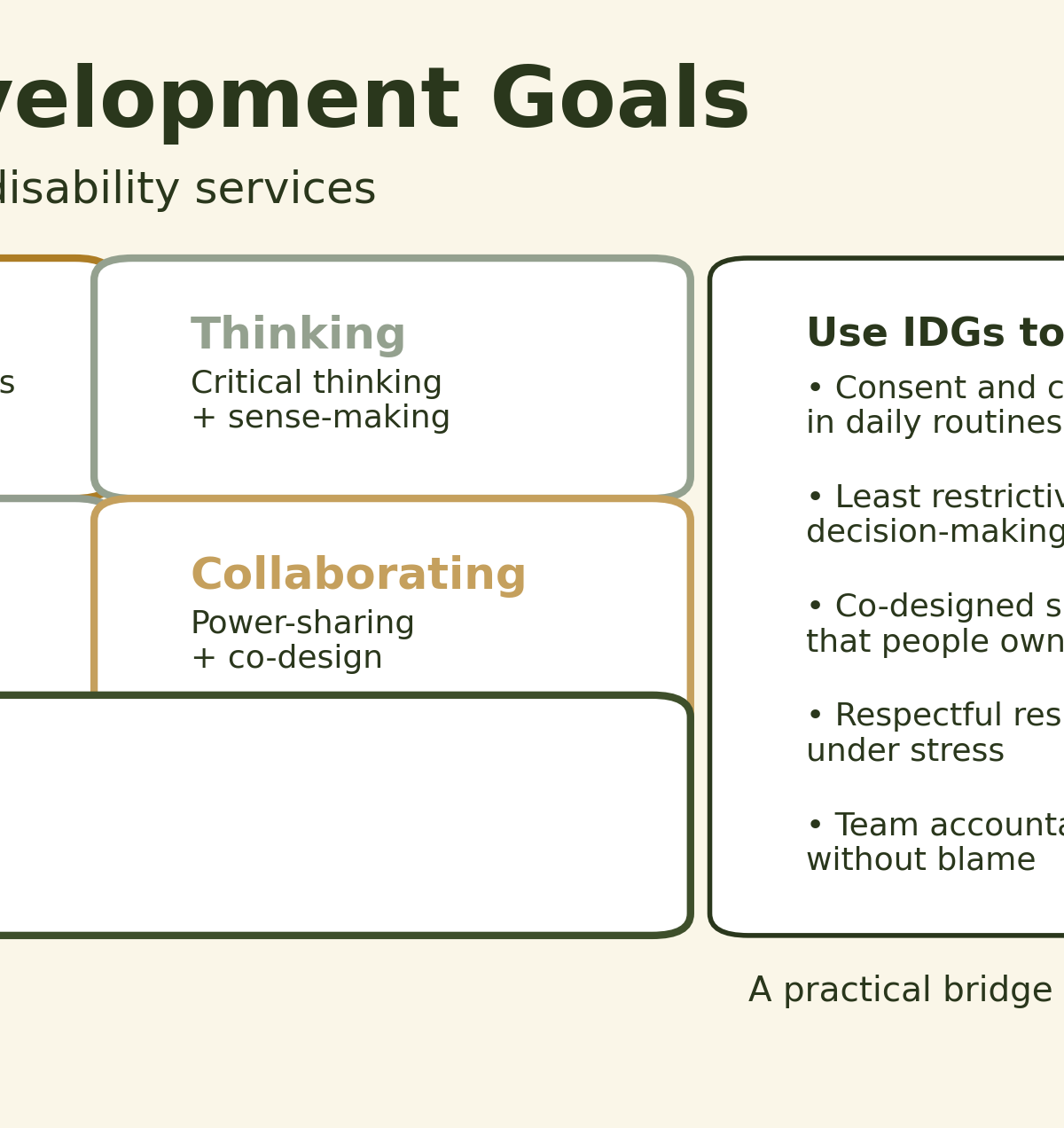
The Inner Development Goals (IDGs) give practitioners a practical way to build the mindset, habits, and team culture needed for a human rights-based approach in disability services — not as a “nice to have”, but as the foundation for everyday decisions.
If you work in disability services, you already know this: policies don’t deliver dignity — people do. It’s the moment-to-moment choices: how we speak, how we respond to distress, how we share power, how we handle risk, and how we listen when someone says “no”.
The IDGs are a simple, research-backed way to build those inner skills. The official IDG Foundation describes the framework as “five dimensions (Being, Thinking, Relating, Collaborating, and Acting) and 23 inner skills and qualities” that help people and organisations develop the abilities needed to address collective challenges. (Inner Development Goals — Support IDGs)
Why the Inner Development Goals matter in disability services
A rights-based approach is bigger than compliance. It asks: are we upholding the person’s dignity, choice, and safety — even under pressure? That takes inner capacity.
The IDGs help teams name the “invisible” parts of practice: emotional regulation, the ability to sit with uncertainty, curiosity instead of judgement, and the courage to challenge harmful norms.
Plain language: IDGs are not another policy. They’re the human skills that make policies real in everyday interactions.
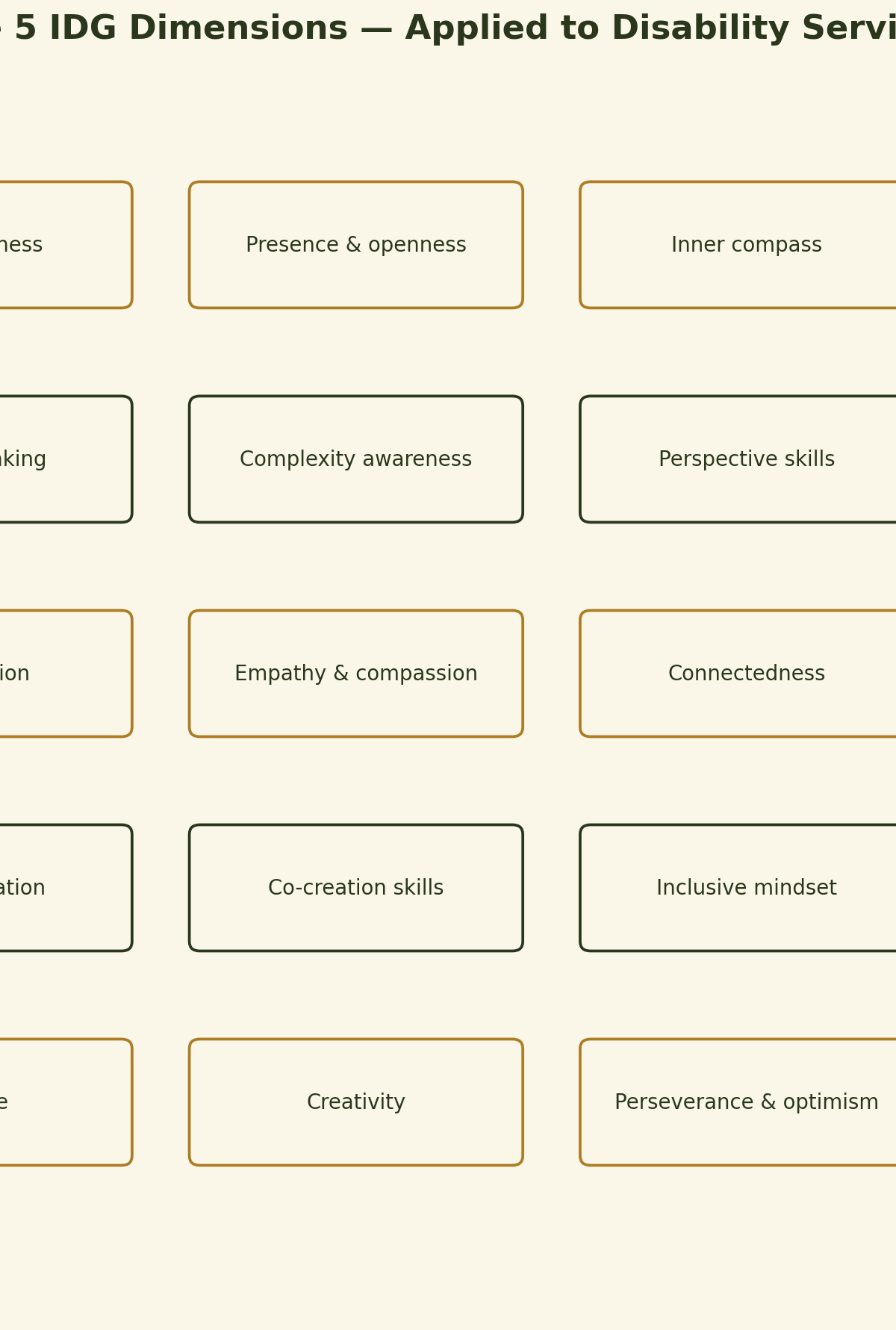
The 5 IDG dimensions (with real examples from practice)
The IDG framework can feel broad at first, so it helps to translate each dimension into real “on shift” behaviours. The goal isn’t to be perfect — it’s to build a shared language for growth.
Being (self-awareness)
Noticing your own stress response before it drives the interaction. Example: pausing before you speak when a situation escalates.
Thinking (sense-making)
Holding complexity without jumping to conclusions. Example: asking “what else could be going on?” before labelling behaviour.
Relating (empathy and care)
Staying connected to the person’s lived experience. Example: checking in on what feels safe, not just what is “allowed”.
Collaborating (power-sharing)
Designing supports with the person. Example: co-writing routines and plans, and respecting “no” as information.
Acting (courage)
Doing what’s right, not what’s easiest. Example: raising concerns about restrictive practices even when it feels uncomfortable.
Key Point: Rights-based practice isn’t a single big decision. It’s hundreds of small decisions that either protect dignity — or slowly erode it.
What changes when teams build these skills?
When teams develop inner capacity together, you usually see practical shifts: fewer “reactive” decisions, clearer communication during tough moments, and better follow-through on what the person actually wants.
Over time, inner development becomes a quality and safety issue. Teams with psychological safety and reflective habits are more likely to identify problems early, listen properly, and change course before harm happens.
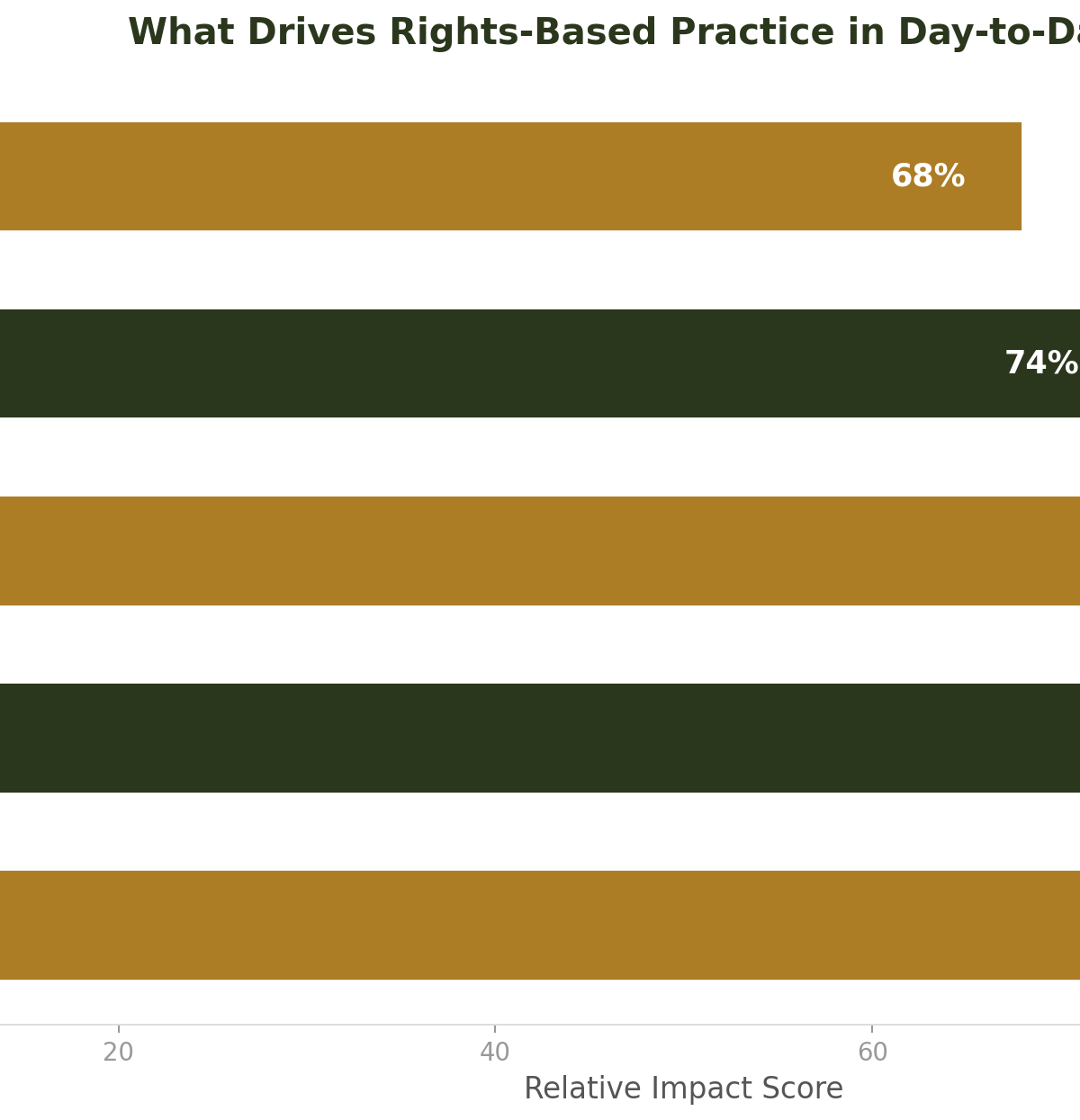
How each IDG dimension supports rights-based practice (quick mapping)
Many providers already have policies for dignity, consent, and least restrictive practice. The gap is usually not knowledge — it’s what happens when the day gets hard.
| IDG dimension | What it looks like on shift | How it supports human rights |
|---|---|---|
| Being | Regulating your tone and body language before you respond | Reduces escalation and protects dignity during conflict |
| Thinking | Curiosity instead of assumptions | Supports fair decisions and avoids harmful labels |
| Relating | Listening with care, especially when the person is distressed | Strengthens consent, trust, and the person’s sense of safety |
| Collaborating | Sharing decisions and planning with the person (and chosen supporters) | Builds choice, control, and meaningful participation |
| Acting | Speaking up when practice drifts from values | Helps services prevent harm and stay accountable |
Mini-scenarios: what IDGs look like in real life
People sometimes hear “inner development” and imagine meditation sessions or abstract reflection. In disability services, it shows up in very practical moments.
❌ What drift can look like
- Staff speak about the person as if they aren’t in the room
- Consent becomes “implied” because everyone is rushed
- Decisions are justified as “for their own good” without real listening
✅ What IDG-informed practice can look like
- Staff pause and check in with the person before making changes
- Teams treat “no” as information and problem-solve with the person
- Workers ask: “What is the least restrictive option that still keeps everyone safe?”
These aren’t “soft” outcomes. They reduce conflict, reduce restrictive responses, and build trust that makes support more effective.
Common trap: Only focusing on training “skills” (procedures, documentation, tools) while ignoring the inner work. Under stress, people fall back to culture — not policy manuals.
A quick HRBA decision loop for the moments that matter
Practitioners often ask for a “simple script” they can use in the moment — especially when the situation is escalating. Here’s a short loop you can teach, practise, and debrief as a team.
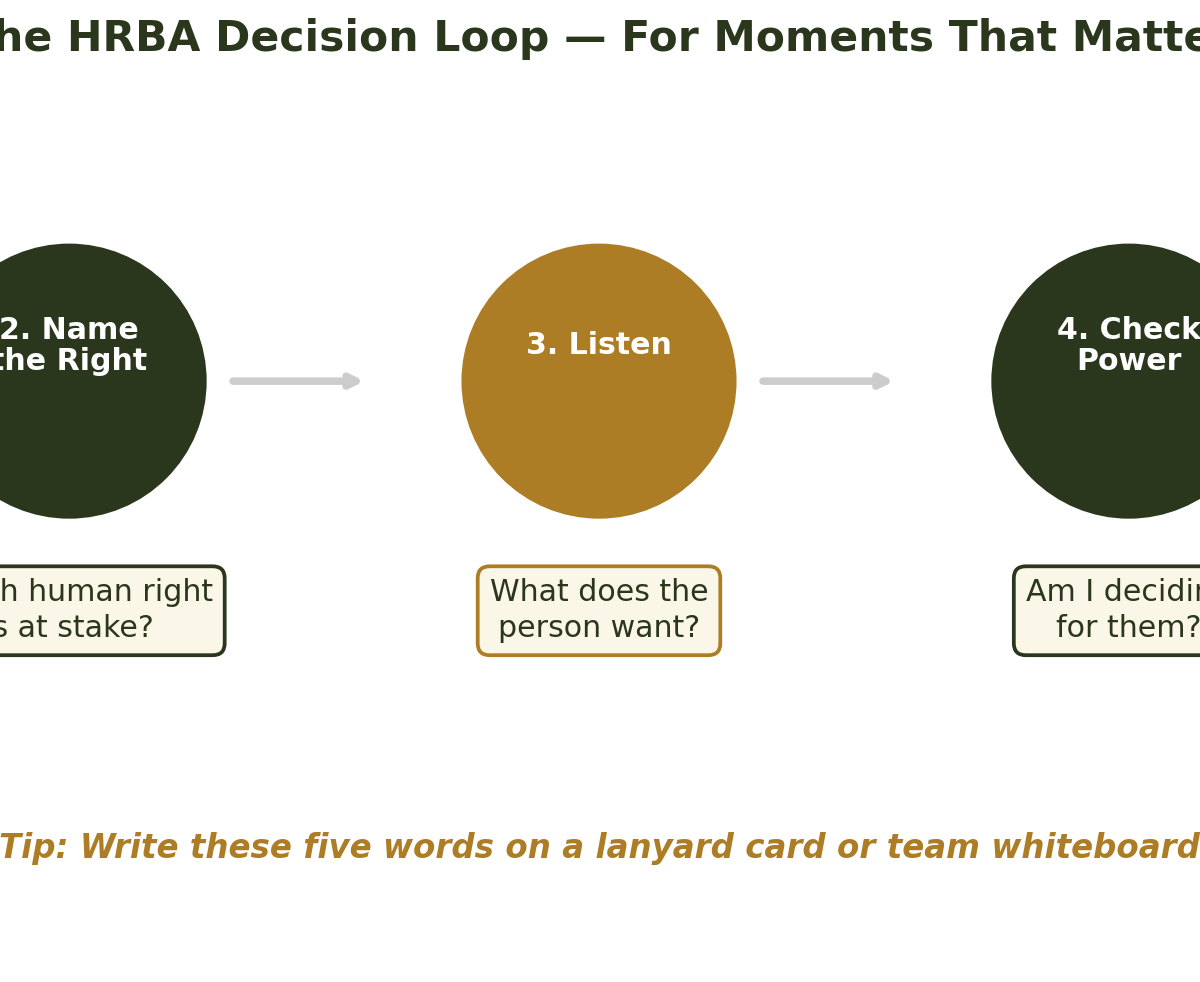
This loop is not about getting the “perfect” answer. It’s about slowing down just enough to choose dignity.
- Notice: what’s happening in the person’s body, behaviour, and environment (and in yours)
- Name the right: ask which human right might be affected (safety, autonomy, communication, privacy)
- Listen: check what the person wants (including non-verbal cues)
- Check power: ask who is deciding, and whether the person can meaningfully influence the plan
- Choose action: take the least restrictive option that is still safe
Team habit: At the end of each shift, pick one interaction and ask: “Where did we share power well? Where did we rush? What would dignity look like next time?”
Supervision and coaching questions (use these weekly)
One of the fastest ways to embed IDGs is to change the questions supervisors and team leaders ask. When the questions change, attention changes.
- Being: “What did you notice in yourself during that interaction?”
- Thinking: “What assumptions did we make — and what evidence do we have?”
- Relating: “What do you think the person experienced in that moment?”
- Collaborating: “Where did the person have real control, and where did we take it?”
- Acting: “What’s one courageous step we can take to improve next time?”
These questions work best when they’re used consistently and with care. The point is learning, not catching people out.
How to embed IDGs in a real workplace (without overwhelming people)
“Do the inner work” can sound vague. The trick is to make it practical and small. Think micro-habits, reflective conversations, and coaching — not big one-off workshops.
Start with one shared definition of “rights-based”
Agree on what dignity, choice, and least restrictive practice look like in your context. Keep it plain language.
Choose 2–3 micro-habits
Examples: pausing before responding, asking permission before touching personal items, using the person’s preferred communication method every time.
Build reflective practice into your week
Short debriefs (10 minutes) beat long meetings that never happen. Keep one question on repeat: “What did the person experience?”
Use lived experience voices as a quality check
Bring people with disability into feedback, co-design, and review. If it can’t be explained and agreed in plain language, it’s not ready.
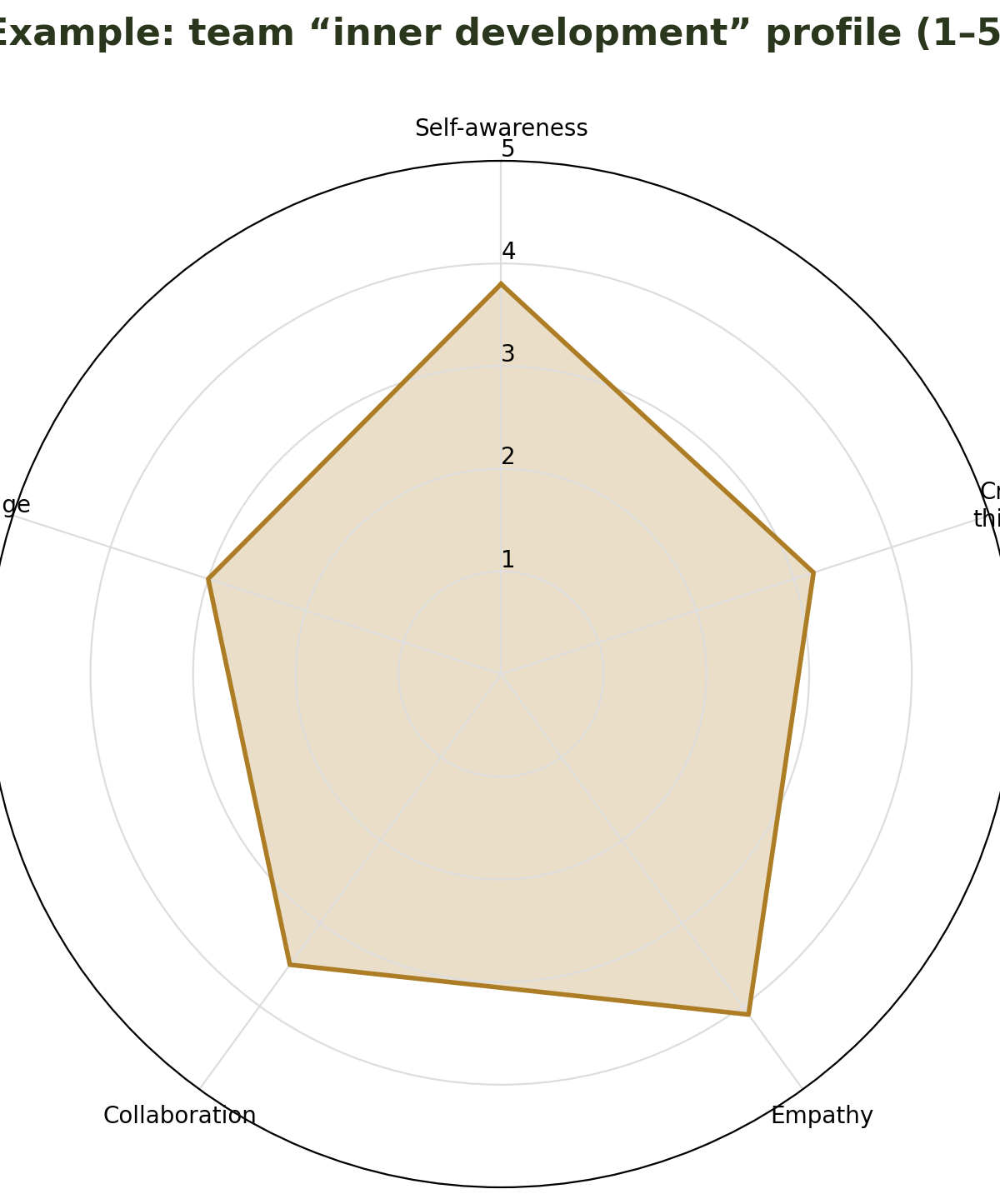
What to watch for: signs your service is drifting from rights-based practice
Drift happens quietly. The service is still “doing the tasks”, but the person starts to feel less in control. These are the warning signs teams can name early.
- People stop asking the person’s permission because it “takes too long”
- Staff use behaviour labels instead of describing needs and contexts
- Incidents are discussed as “compliance” rather than “what did the person experience?”
- Plans are written about the person, not with the person
- New staff are taught shortcuts before values
If you recognise any of these, it’s not a reason for blame. It’s a reason to slow down and rebuild the basics: consent, communication, co-design, and reflection.
An 8-week rollout you can actually run
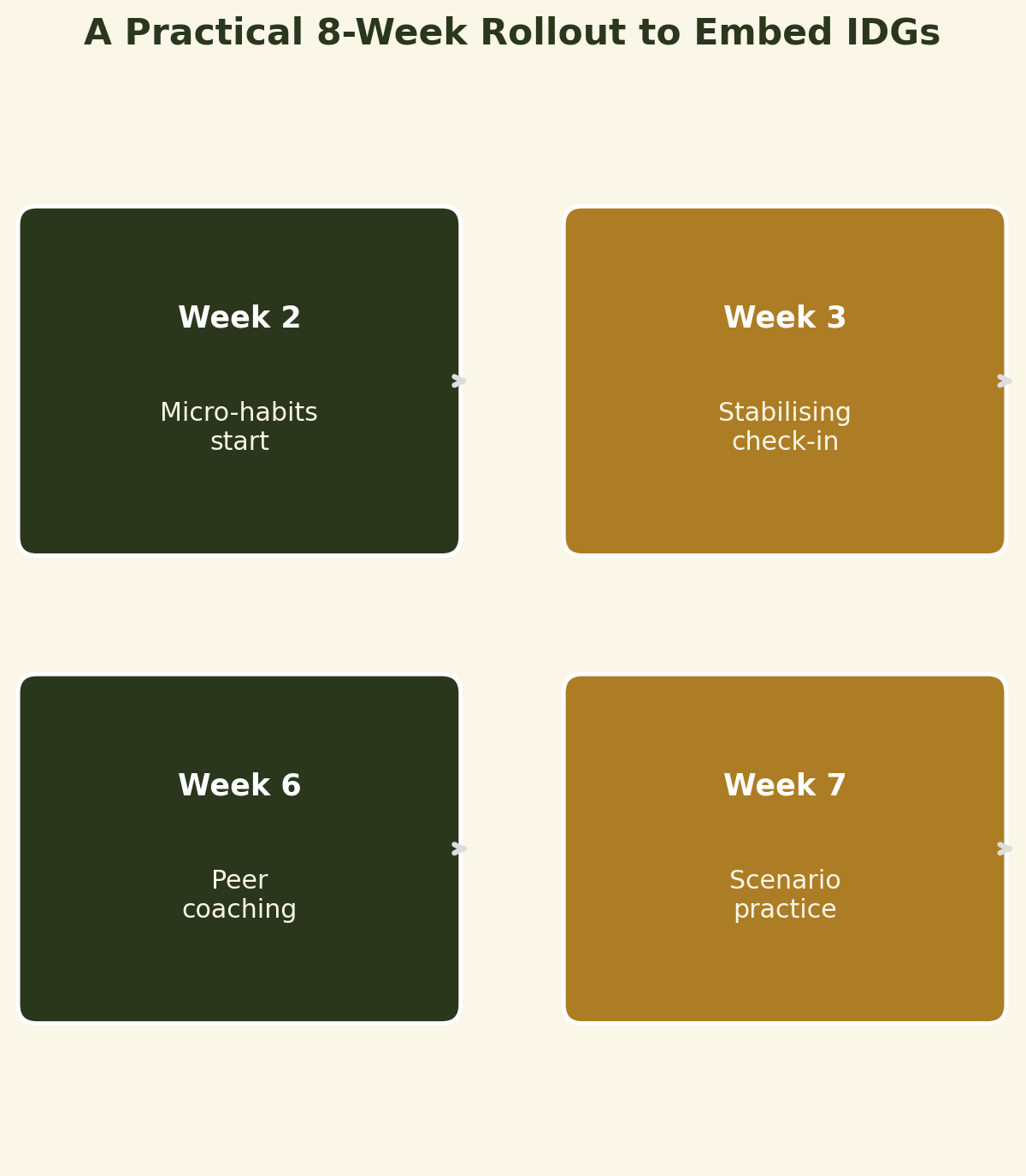
If you want something concrete, try an 8-week cycle. It’s long enough to build momentum, and short enough to feel achievable.
Set the baseline
Agree on a shared definition of rights-based practice, and identify 2–3 micro-habits to practise as a team.
Practise under real conditions
Use short debriefs after real situations. Track what changed for the person, not just the paperwork.
Strengthen accountability
Add peer coaching and scenario practice. End with a review and choose the next focus without starting from scratch.
Culture change is often most visible in the “small stuff”: how quickly people apologise, how often people ask for consent, and whether feedback is welcomed instead of punished.
How B-HART uses IDGs (and why it fits certification)
Rights-based practice needs more than a policy folder. It needs consistent behaviours that hold up under fatigue, complexity, and risk.
That’s where IDGs fit naturally. They give teams a shared, non-shaming way to talk about what matters: presence, empathy, power-sharing, and courage. When those capacities are built into routines (induction, supervision, incident debriefs, co-design sessions), rights-based practice stops being a slogan.
Practically, you’ll often see IDGs show up in three places:
- Induction: new staff learn the service’s “non-negotiables” for consent, communication, and dignity — and practise them with real scenarios.
- Supervision: coaching focuses on the moment that mattered (tone, pace, power) instead of only the documentation.
- Incident learning: debriefs ask “what did the person experience?” and “what inner skill would help next time?” rather than blaming individuals.
This is how culture becomes measurable: not by counting training hours, but by seeing whether daily interactions consistently protect the person’s rights.
Key Point: The goal is not to “rate” workers. The goal is to build a service where dignity is the default — even on the hard days.
Key Takeaways
- The Inner Development Goals give teams a shared language for the human skills behind rights-based practice.
- The five dimensions (Being, Thinking, Relating, Collaborating, Acting) map well to everyday service decisions.
- Embedding IDGs works best through micro-habits, reflective practice, and power-sharing — not one-off training.
- A short rollout cycle (like 8 weeks) helps teams build momentum and review change without overwhelm.
A note for leaders: make it safe to learn
Inner development doesn’t grow in fear. If the workplace runs on blame, people will hide mistakes and defend themselves — and the person with disability will feel the cost.
Leaders don’t need to have all the answers. They do need to make it safe to be honest: “I got that wrong”, “I was triggered”, “I rushed”, “I didn’t listen properly”.
If you want a simple rule, try this: protect learning time the same way you protect medication safety, incident reporting, and infection control. It’s not optional — it’s part of safe service delivery.
Leadership move: Treat reflective practice like a safety system. Schedule it, protect it, and model it — even when the roster is tight.
Frequently Asked Questions
Are the Inner Development Goals the same as the Sustainable Development Goals?
No. The Sustainable Development Goals (SDGs) focus on external outcomes. The Inner Development Goals focus on the inner skills and qualities that help people and organisations create those outcomes.
How do IDGs help with restrictive practices and behaviour support?
IDGs support the “human side” of practice: regulation under stress, curiosity, empathy, and courage to ask hard questions. Those inner skills help teams choose least restrictive options and stay focused on dignity.
What’s the first step a provider can take this week?
Pick one micro-habit (like pausing before responding, or asking permission more consistently) and pair it with a 10-minute weekly debrief. Change sticks when it becomes routine.
Want to build a rights-based culture that holds up under pressure?
B-HART helps providers move beyond compliance and embed a human rights-based approach in everyday practice — with tools, training, and certification pathways.
Talk with B-HARTYou can also read more about our approach and explore resources and updates.