
If you’re exploring NDIS provider registration, you’re probably juggling two things at once: building a quality system that will stand up to audit, and building a service culture that people with disability actually want to be part of. This guide breaks down the registration pathway, the quality audit, and the practical evidence you’ll need — with a clear human rights lens, not just a compliance checklist.
Important: Some supports must be delivered by registered providers (for example, supports for participants with NDIA-managed funding, SDA, and specialist behaviour support). Check the NDIS Commission guidance and seek your own advice if you’re unsure what applies to your organisation.
What “NDIS provider registration” actually means
In plain language, registration is how the NDIS Quality and Safeguards Commission checks that a provider is safe, suitable, and ready to deliver supports to people with disability. Registration isn’t just a form — it’s a decision based on your audit results, your governance, and the suitability of your organisation and key personnel.
Done well, registration becomes a foundation for trust: clear service agreements, safe incident response, strong complaints handling, and workers who understand how to support choice and control. Done poorly, it becomes “paper compliance” — and that’s where people get hurt.
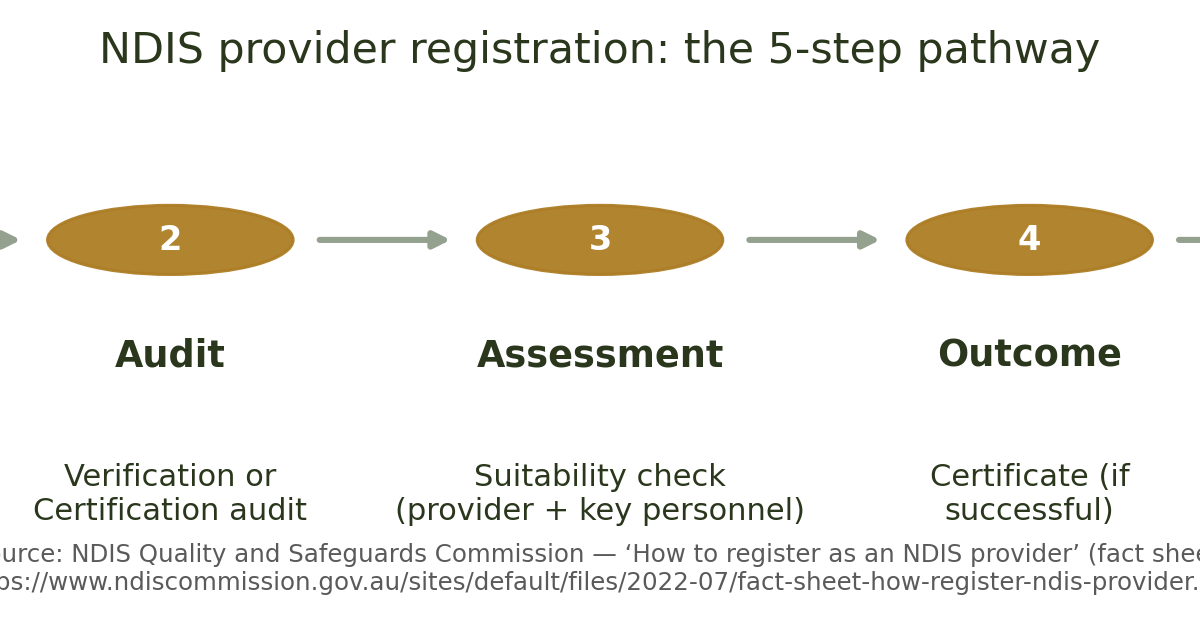
The 5-step pathway (and what to focus on in each step)
Apply
You submit your application through the NDIS Commission portal. This is where you define your “service profile” (what you do, where you do it, and which registration groups you’re applying for). A strong application is specific — it matches your real delivery model and doesn’t over-claim.
Audit
An independent approved quality auditor assesses you against the relevant NDIS Practice Standards. The evidence you prepare here should show what you say (policies) and what you do (records, training, supervision, participant feedback, incident actions).
Assessment
The NDIS Commission assesses suitability — including the provider and key personnel. This is where governance matters: clear decision-making, role clarity, and genuine oversight (not rubber-stamping).
Outcome
If successful, you receive a Certificate of Registration with your registration groups, conditions, and the registration period. If unsuccessful, you can request a review within the timeframe the Commission outlines.
Meet registration requirements (ongoing)
Registration is not “set and forget”. You need to keep your systems working in real life: complaints, incidents, worker screening, and notifications. If you use regulated restrictive practices or deliver behaviour support, your reporting and governance requirements increase.
Practical tip: Build your evidence set as you go. Don’t wait for the audit to start. Create a simple folder structure: governance, workforce, service delivery, complaints, incidents, participant feedback, and continuous improvement.
Verification vs certification audits: what’s different (and why it matters)
The audit type you need depends on the supports and services you plan to deliver. For lower risk, lower complexity supports, providers may undergo a verification audit (a desktop evidence review). For higher risk or more complex supports, providers need a certification audit (desktop + onsite stages).
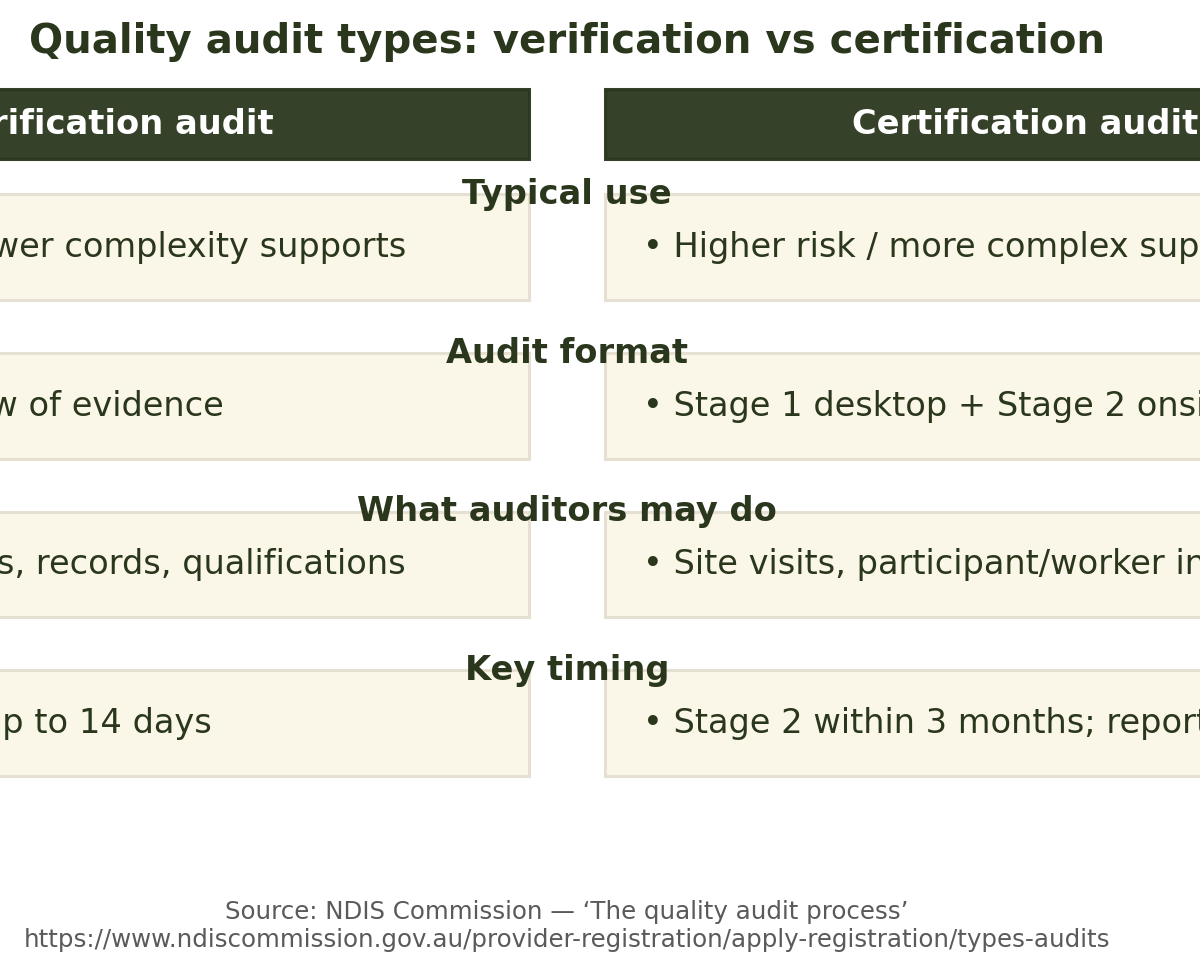
Common mistake: Treating the audit as a “document submission”. Auditors look for signs your policies are alive: induction records, supervision notes, participant communication, and examples of improvements you made after feedback or an incident.
The evidence auditors look for (a practical checklist)
Evidence varies by provider size and scope, but most organisations will need to demonstrate strong systems in the areas below. This isn’t about producing perfect paperwork — it’s about showing you can run a service that is safe, transparent, and respectful.
One useful way to think about evidence is that it should answer three questions: Is it clear? (could a participant understand it), is it consistent? (do workers follow it the same way), and is it improving? (can you show you learn when something goes wrong).
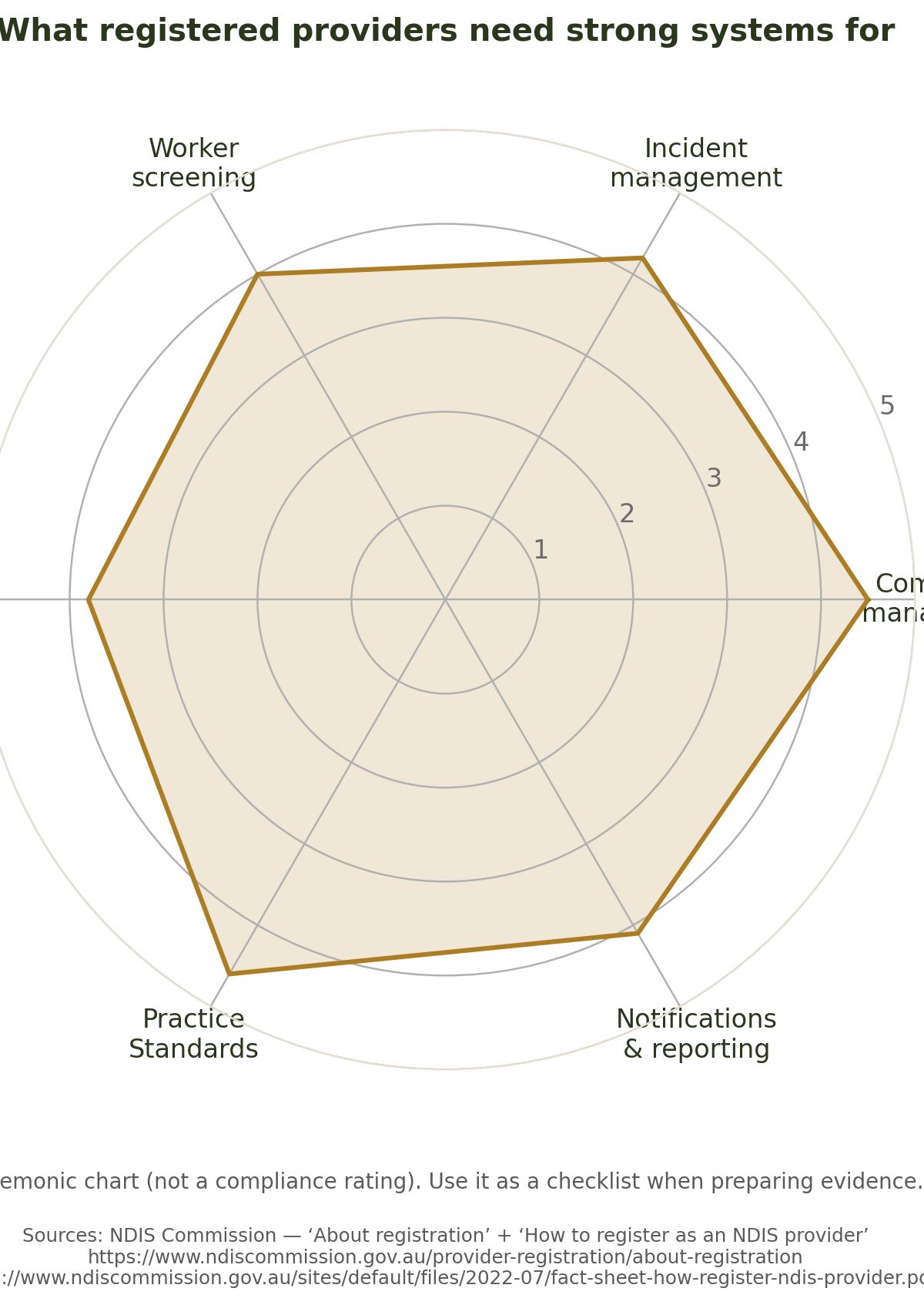
- Complaints management: a clear pathway, accessible formats, and evidence you action feedback (not just record it)
- Incident management: definitions, response timeframes, debrief process, and reportable incident notifications where required
- Worker screening: a process for checking and tracking clearances for relevant roles (including key personnel where applicable)
- NDIS Code of Conduct: training, supervision, and a culture where workers can speak up early
- NDIS Practice Standards: policies and procedures mapped to what you actually deliver
- Notifications and reporting: you know what must be notified, when, and who is accountable
| Evidence area | What “good” looks like | Examples you can show an auditor |
|---|---|---|
| Service access & information | People can understand what you do, what it costs, and how to raise a concern. | Easy-read information, interpreter access notes, participant welcome pack, service agreements. |
| Workforce capability | Workers know the Code of Conduct and how to support choice and control. | Induction checklist, training attendance, supervision notes, competency sign-offs. |
| Incident response | Incidents are handled quickly, transparently, and used to prevent repeats. | Incident register, debrief notes, corrective actions, notifications (where required). |
| Complaints & feedback | Complaints feel safe to make and lead to real change. | Complaints log, “you said / we did” improvements, participant survey summaries. |
| Governance & oversight | Leadership actively monitors quality and risk, not just finances. | Board/leadership minutes, risk register, quality dashboard, internal audit schedule. |
Where human rights fits: registration as a culture test, not just compliance
Registration can feel like a technical process, but it’s also a values test. A Human Rights-Based Approach shows up in the details: how you explain service agreements, how you respond when someone is unhappy, how you involve people in decisions, and how you prevent restrictive practices from becoming “business as usual”.
When providers use registration as an opportunity to build rights-based systems, the benefits flow both ways: participants get safer, more respectful services, and providers build trust, stability, and workforce confidence.
❌ When registration becomes “paper compliance”
- Policies exist, but workers can’t find them (or don’t use them)
- Complaints are treated as threats, not learning
- Incidents are minimised or handled inconsistently
- People feel rushed, unheard, or disempowered
✅ When registration supports human rights in practice
- Policies are simple, trained, and used in everyday decisions
- Complaints are welcomed and lead to visible change
- Incidents trigger learning and prevention, not blame
- People experience choice, dignity, and safety
If you want one “north star” question to guide your preparation, use this: Would a participant recognise themselves in our policies? If the answer is no, co-design and plain-language review are your best next steps.
“If your systems only work on paper, people will feel it. If your systems protect dignity in real moments — people will feel that too.”
— A rights-based way to think about audit evidenceCo-design: the fastest way to make your policies real
“Nothing About Us Without Us” isn’t a slogan. It’s a practical method for building systems that people can use. Co-design helps you test whether your complaints pathway is understandable, whether incident responses feel safe, and whether your service agreements actually support choice and control.
If you’re preparing for audit, co-design also helps you build evidence that is hard to fake and easy to trust. It shows your organisation can listen, adapt, and explain decisions transparently — especially when the topic is sensitive (privacy, restrictive practices, medication support, or personal care).
Start small and be clear about the purpose. For example, you might invite 3–5 people with disability (and/or family members) to review your complaints information in plain language, then run a second session to test the updated version. The “audit win” is not that you held a workshop — it’s that you changed the document and can show why.
Co-design needs to be safe. That means consent, options to pause, paying people for their time where possible, and supports that make participation accessible (Auslan, interpreters, quiet spaces, breaks, easy-read materials). When it’s done well, it strengthens both quality and human rights.
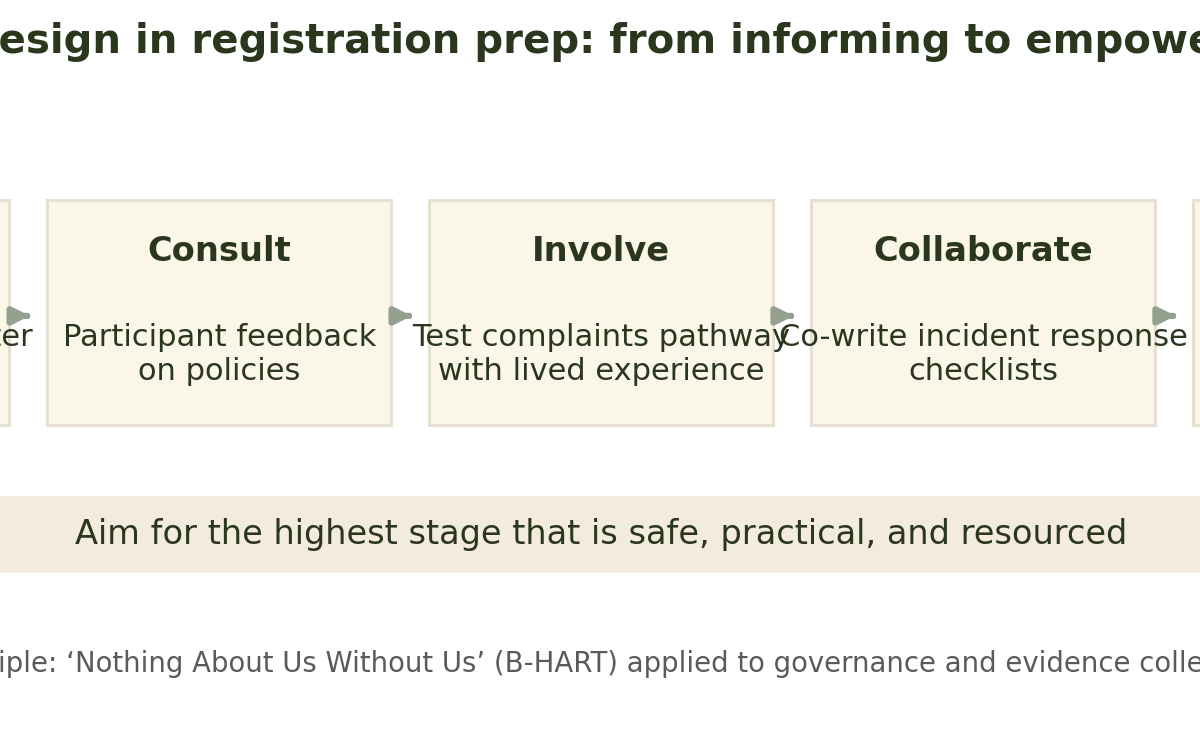
- Start with accessible information: create a short, easy-read service charter and rights information pack.
- Test one pathway: run a lived-experience walkthrough of your complaints process and rewrite what’s unclear.
- Co-write one tool: build an “incident response checklist” with people who have used services.
- Build ongoing feedback: set up regular participant feedback loops (not just annual surveys).
- Strengthen governance: consider a participant advisory group with a clear role and safe supports.
What co-design looks like in evidence
- Notes showing what people said, what you changed, and what you’ll test next
- Accessible versions of key documents (complaints, incidents, service agreements)
- Feedback logs and “you said / we did” updates
What co-design is not
- A single consultation session with no follow-up
- A glossy brochure that isn’t used in practice
- Asking people to share lived experience without support, safety, or payment
Registration-ready: a simple 30-day action plan
If you’re starting from scratch (or cleaning up a messy system), a 30-day plan helps you build momentum without overwhelming your team. Adjust the timing to fit your audit schedule and the supports you deliver.
Map your scope and risks
Confirm which registration groups you’re applying for, map your service model (sites, hours, worker roles), and create a simple risk register for quality and safeguarding.
Build “minimum viable” policies and training
Create plain-language policies for complaints and incidents, set induction and supervision routines, and make sure workers can explain the Code of Conduct in their own words.
Test with people with disability
Run a co-design walkthrough of your complaints pathway and service agreement. Document what changed and why, and confirm accessibility supports.
Do an internal “mock audit”
Pick 10 random records (induction, incident, complaint, supervision) and check for consistency. Fix gaps, then prepare your evidence pack and engage an approved auditor.
Quick win: Write a one-page “quality snapshot” for leadership that is reviewed monthly: complaints count, incidents count, improvements made, training completed, and participant feedback themes. It becomes ongoing evidence — not a last-minute scramble.
Key Takeaways
Key Takeaways
- NDIS provider registration follows five steps: apply, audit, assessment, outcome, and ongoing requirements.
- Audit type depends on the supports you deliver: verification is a desktop review, while certification includes onsite assessment.
- Strong evidence shows your systems working in practice: complaints, incidents, worker screening, and continuous improvement.
- Rights-based practice isn’t separate from compliance — it’s the difference between “paper systems” and safe services.
- Co-design is a practical way to strengthen policies and prove your systems are understandable and usable.
Frequently Asked Questions
Do I need to be a registered provider to deliver NDIS supports?
It depends on the supports and how the participant’s funding is managed. The NDIS Commission lists supports where registration is mandatory (for example, NDIA-managed supports, SDA, specialist behaviour support, and plan management). If you’re unsure, check the Commission guidance and get advice for your specific service model.
What’s the difference between verification and certification audits?
A verification audit is usually a desktop review for lower risk supports. A certification audit is for higher risk or more complex supports and includes desktop and onsite stages, where auditors can visit sites and interview workers and participants.
What’s the biggest thing that causes providers to struggle at audit?
Gaps between policy and practice. The quickest fix is to build simple routines: induction and refresher training, supervision notes, accessible complaints information, and a clear way to show improvements you made after feedback or incidents.
How do human rights connect to provider registration?
Human rights show up in the “everyday systems”: how you protect choice and control, how you respond when someone feels unsafe, and how you avoid restrictive or disempowering practices. A rights-based approach makes compliance meaningful because it’s grounded in dignity.
Want to build a rights-based quality system (not just pass an audit)?
B-HART supports providers to embed human rights in everyday service delivery — including governance, workforce capability, and practical tools that stand up in real life.
Explore B-HART supportsYou can also learn more about B-HART Certification and our Human Rights-Based Approach.