
Participant voice and co-production in disability services isn’t a buzzword. It’s what happens when people with disability help shape the supports they use — not as an afterthought, but as partners with real influence.
Co-production goes beyond “we asked for feedback” and moves toward “we built it together”. This guide is for providers and leaders who want practical ways to listen well, share power, and avoid tokenism — while strengthening quality systems and building trust with the people they support.
Plain-language definition
Co-production means people with disability and service providers share power in decisions about how supports are designed, delivered, and improved.
Participant voice is not a nice extra. It’s part of a human rights approach — and it’s baked into what quality looks like under the NDIS Practice Standards. The challenge is that plenty of organisations try to “do engagement” and still leave people feeling unheard.
If you’re leading a provider, you’ve probably seen both ends of the spectrum: a feedback form that goes nowhere, and a small change that makes a person’s day easier because someone finally listened. The difference is rarely intent. It’s structure. It’s time. It’s whether people are supported to contribute in ways that work for them.
Why participant voice matters (human rights, not just reputation)
When a person’s voice is sidelined, the result is usually predictable: supports that don’t fit, avoidable incidents, and staff doing “their way” instead of the person’s way. When voice is centred, supports tend to be safer, more respectful, and more sustainable.
The NDIS Practice Standards interpretive guide is explicit that person-centred supports must “promote, uphold and respect” human rights and enable “informed choice and control.” (NDS – NDIS Practice Standards Interpretive Guide)
That matters because “quality” isn’t only about policies on a shelf. It shows up in moments like:
- how workers speak to a person when they are stressed
- whether a person can say “no” without punishment
- whether communication supports are built in, not improvised
- whether leadership decisions reflect what participants said matters
Key Takeaways
- Participant voice is a human rights issue: choice, control, and dignity.
- Co-production needs structure, time, and supported decision-making.
- Governance matters: boards and executives must be able to show “you said / we did”.
- Tokenism is usually a design problem — and it’s fixable.
Co-design, co-production, and “engagement”: what’s the difference?
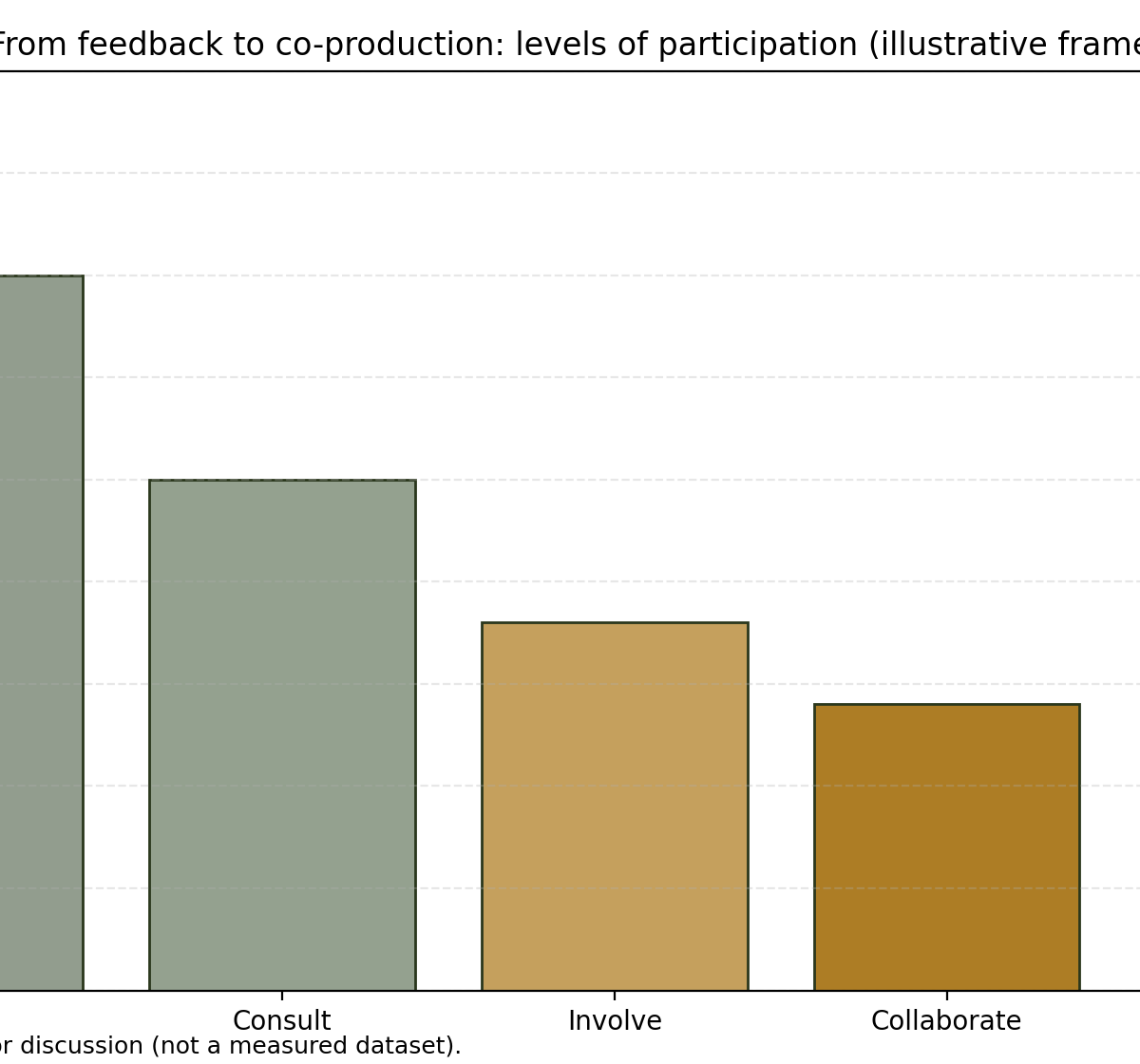
These terms get mixed up, and that’s where organisations accidentally become tokenistic. A simple way to separate them:
| Approach | What it often looks like | Risk if done poorly |
|---|---|---|
| Feedback | Surveys, complaints, review forms | People feel “asked but ignored” |
| Consultation | Focus groups, reference groups, workshops | Decisions are already made |
| Co-design | Designing a program together before launch | People are involved, but power still sits with the provider |
| Co-production | Ongoing shared decisions in design + delivery + evaluation | Without governance, it becomes symbolic |
“Co-design isn’t having conversations behind closed doors. It’s drafting workable legislation with people with disability… out in the open with people with disability leading the way.”
— People with Disability Australia (PWDA), responding to NDIS reformsIn practice, your organisation can use all four approaches — but the key is honesty. If you’re only collecting feedback, call it feedback. If you’re making shared decisions, design the conditions to make that real.
What the NDIS Practice Standards expect (and why governance matters)
Participant voice isn’t only about frontline interactions. Governance has a role too — because policies and processes shape what workers can do day-to-day.
The interpretive guide notes: “Opportunities are provided by the governing body for people with disability to contribute to the governance of the provider and have input into the development of organisational policy and processes relevant to the provision of supports and the protection of participant rights.” (NDS – NDIS Practice Standards Interpretive Guide)
This is where many providers get stuck. They can show “we collect feedback”, but can’t show:
- how feedback changed decisions
- how participants were supported to take part (reasonable adjustments)
- how the board (or leadership) listened and acted
Tip: If your leadership meeting minutes never mention participant feedback, you may have a “frontline voice” system but no “governance voice” system.
Supported decision-making: the practical bridge to real voice
Co-production becomes unrealistic if a service assumes everyone communicates the same way, processes information the same way, or can make decisions quickly under pressure.
Supported decision-making is about creating conditions where a person can understand options, weigh up risks, and communicate their will and preferences — with support when needed, without having decisions taken over.
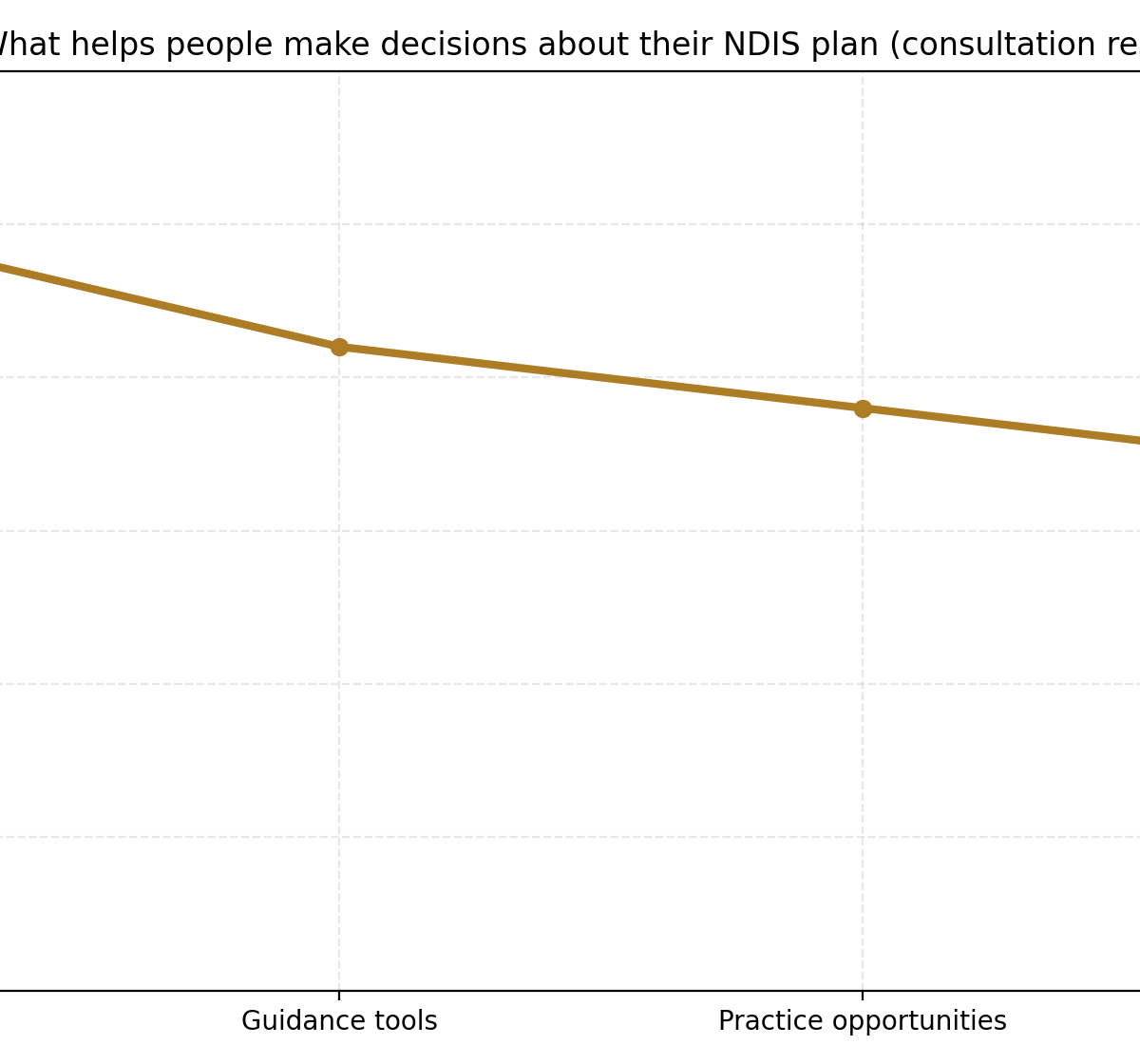
In NDIA consultation work on supporting people to make their own decisions, participants highlighted that what helps most includes information and resources, guidance tools, practice opportunities, and peer networks. (NDIS Engage – Supporting you to make your own decisions)
What this looks like in everyday service moments
Supported decision-making isn’t a special project. It can be built into everyday moments where people are most likely to feel rushed or unheard.
Service agreements
Share options early, use plain language, and allow time to talk it through.
Choosing workers
Offer real choice (including gender preferences) and explain what’s possible.
Incidents and complaints
Slow down, use trauma-informed communication, and involve the person in the response.
Ongoing check-ins
Ask what’s working, what isn’t, and make changes quickly when something doesn’t fit.
A practical co-production model you can start this month
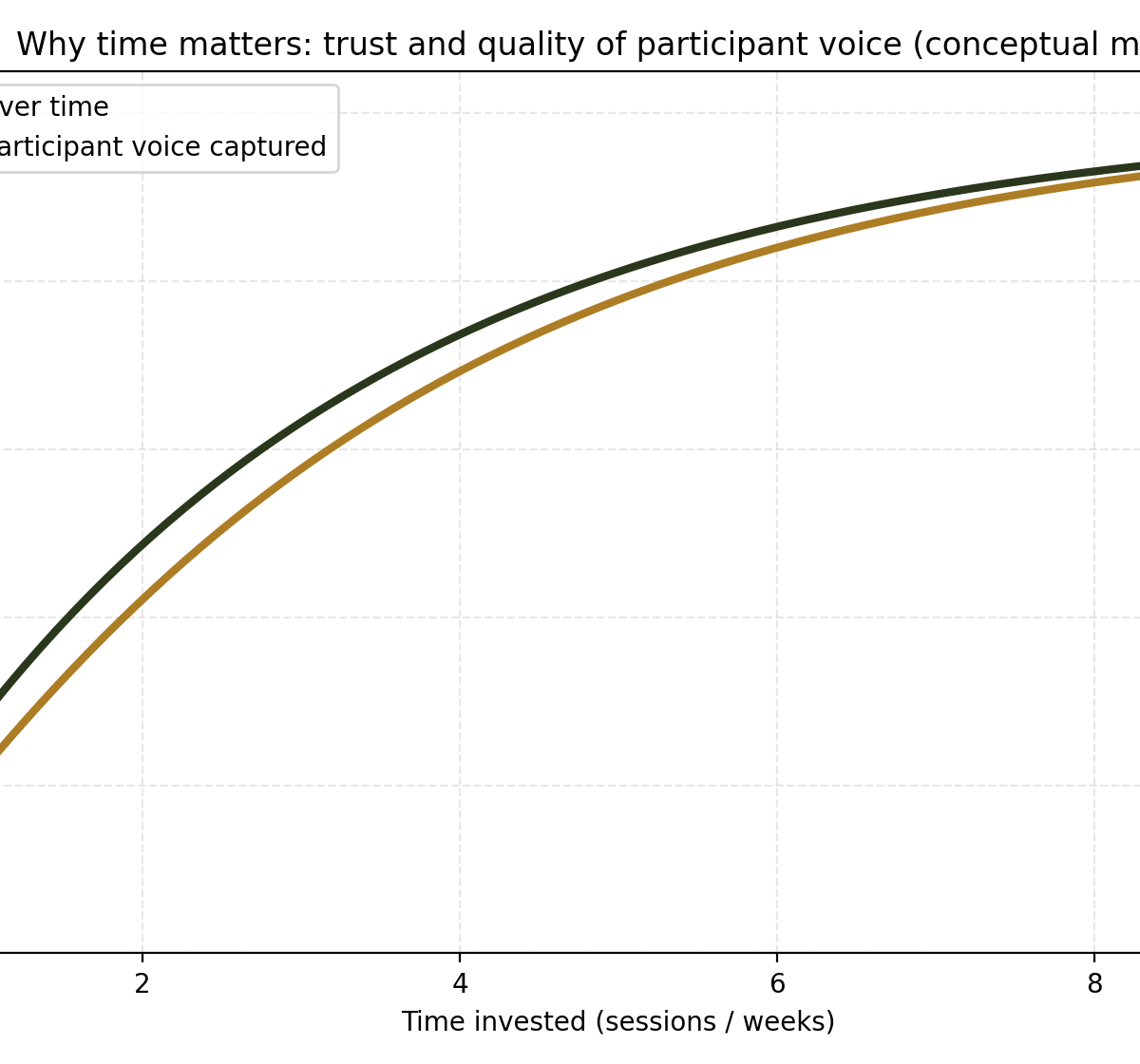
If your organisation is busy, start with a small structure that’s predictable and respectful. Consistency is where trust comes from.
It also helps to be clear about the type of decisions you’re sharing. Some decisions are personal (what a person wants today). Some are operational (how rosters are built). Some are strategic (what you invest in next quarter). Co-production gets easier when you name the decision type and the boundary.
❌ Tokenistic engagement
- Ask for opinions once the plan is finished
- Run meetings that are fast, jargon-heavy, and inaccessible
- Collect feedback without publishing what changed
- Rely on one representative to speak for everyone
✅ Co-production that works
- Invite people early, before decisions are locked in
- Build reasonable adjustments into the process from day one
- Share power through clear decision-making and follow-through
- Use multiple ways to hear voice (not just meetings)
Another practical shift is moving from “consultation questions” to “design questions”. Consultation questions ask for opinions. Design questions invite people to shape the solution. For example:
- Consultation: “Are you happy with our onboarding?”
- Design: “What should happen in the first week so you feel safe, informed, and in control?”
- Consultation: “Do you like your roster?”
- Design: “What would a good match with a support worker look like for you — and what are red flags?”
These questions often surface details that policies miss: sensory needs, cultural safety, privacy, gender preferences, trauma triggers, or communication supports. Those details are where quality lives.
- Pick one “service moment” to improve (e.g., onboarding, matching workers, incident follow-up, plan review support).
- Invite a small group of participants with diversity of experience (including people with complex communication where possible).
- Support participation properly: transport, accessible info, interpreters, AAC support, support persons — whatever makes it meaningful.
- Share power in decisions: be clear about what’s genuinely changeable and what isn’t (and why).
- Close the loop: publish “you said / we did” in accessible formats.
To make this concrete, choose one of these “small-but-high-impact” topics to co-produce:
- how you introduce new workers to a person (and what information is shared)
- how you handle “change requests” mid-service agreement
- how you involve the person in incident follow-up meetings
- how you support people to make decisions when they are tired, distressed, or overwhelmed
How to avoid tokenism (common traps)
One of the easiest ways to reduce tokenism is to treat accessibility as a design requirement, not a favour. If you only make adjustments “when someone asks”, you’ll mostly hear from people who already have the confidence and energy to ask — and you’ll miss the voices that matter most.
Build a simple adjustments checklist into every engagement activity: how information will be shared (plain language, Easy Read, visuals), how people can communicate (AAC, chat, supported conversation), how time will be structured (breaks, shorter sessions), and how decisions will be documented and fed back.
Also remember that co-production isn’t only meetings. Some people prefer one-on-one yarns, short voice notes, picture-based choices, or “try it and tell us” sessions in real environments. The best approach is usually a mix, so people can participate in ways that work for them.
Most tokenism isn’t malicious. It’s usually the result of rushing, using inaccessible processes, or only asking questions that are “safe” for the organisation.
Tokenism warning signs
- People are invited after decisions are already made.
- Meetings are inaccessible (jargon, fast pace, no communication supports).
- Participants do unpaid labour with no recognition or support.
- Feedback is collected but never reported back.
One of the most common problems is “fast engagement”. A provider wants to be responsive, so it rushes a workshop without doing the basics: accessible materials, clear purpose, and time for relationships. People show up, feel confused, and leave thinking the provider only wanted a tick-box.
Instead, do fewer engagement activities — but do them properly. It’s better to co-produce one service improvement with a small group than to run three inaccessible consultations that produce no change.
Three audit-ready ways to prove participant voice is shaping your service
Auditors don’t just want to see that you asked. They want to see what changed.
Evidence that shows “voice”
- Accessible agendas and Easy Read summaries
- Communication supports provided (AAC, interpreters)
- Supported decision-making tools and prompts
- Consent records for sharing information
Evidence that shows “power”
- Decision logs showing what changed
- Policy revisions linked to participant input
- Board minutes that discuss participant feedback
- Quality improvement plans that include participant priorities
FAQ: participant voice and co-production in disability services
Is co-production required under the NDIS Practice Standards?
The Practice Standards don’t use the word “co-production” everywhere, but they do require person-centred supports, active decision-making, accessible information, and participant involvement — including opportunities for people with disability to contribute to governance. (NDS – NDIS Practice Standards Interpretive Guide)
What if a participant doesn’t want to be involved?
Participant voice includes the right to opt out. The goal is to offer meaningful opportunities and adjust the method to what works for the person — not to force participation.
How do we include people with complex communication?
Plan for communication supports from the beginning (AAC, interpreters, trusted supporters, time, visual formats). Supported decision-making approaches help services avoid “speaking for” a person when the person can speak differently. (NDIS Engage)
How do we pay people for their time?
Paying people with lived experience for advisory work is good practice. If you’re unsure, start by covering costs (transport, support worker time where needed) and be transparent about options.
How do we prove we’re not tokenistic?
Show the full loop: how you invited people, what adjustments you made so participation was meaningful, what they raised, what decisions were made, and what changed.
Ready to strengthen participant voice in your organisation?
Start with one service moment and co-produce the improvement with the people who use it. Small changes build trust — and trust changes everything.
If you want a practical next step, choose a single policy or process you already review each quarter (for example: incident response, onboarding, or worker matching). Invite lived experience input early, support participation properly, and document what changed. Over a year, that approach creates a clear “rights in action” trail — for participants, for staff, and for governance.
Explore B-HART CertificationOr learn more about our approach to human rights in everyday services: About B-HART.