
Trauma-informed care in disability services is not a trend or a buzzword. It's a fundamental shift in how support services are designed and delivered — one that recognises the reality that many people with disability have experienced trauma, and that the way services respond to them can either reinforce harm or help people heal. Getting this right isn't optional. It's both a legal requirement and a moral one.
Why Trauma-Informed Practice Matters in Disability Services
People with disability experience trauma at significantly higher rates than the general population. Research published by the Blue Knot Foundation consistently shows that people with disability are more likely to have experienced abuse, neglect, institutionalisation, and repeated violations of their rights — often at the hands of the very services that were meant to protect them.
Yet for decades, disability services were designed around compliance, control, and efficiency. Support workers were trained to manage behaviour, not to understand its roots. When a participant became distressed, the standard response was often to escalate restrictions rather than ask: what happened to this person, and what do they need to feel safe?
Trauma-informed care in disability services reframes the entire question. Instead of asking "what's wrong with this person?", practitioners ask "what happened to this person, and how can we make this environment safer for them?" That single shift changes everything — from how services are scheduled, to how workers communicate, to how decisions are made.

What Trauma-Informed Care Is — and What It Isn't
There's a lot of confusion about what trauma-informed care actually means in practice. One of the most important things to understand from the outset is that trauma-informed care is not therapy. It doesn't require support workers to become counsellors. It doesn't mean asking people about their trauma histories. And it doesn't mean treating every person with disability as if they're fragile or broken.
What trauma-informed care is NOT: Trauma-informed practice is not about identifying or treating trauma directly. It's an organisational approach — a set of principles embedded into how services are designed, delivered, and continuously improved. Support workers are not therapists, and trauma-informed care doesn't ask them to be. It asks them to create conditions where people feel safe, respected, and in control.
What trauma-informed care IS is an approach that changes the default culture of a service. It means designing systems so that people have choice and control. It means building trust through consistency and transparency. It means training workers to recognise that what looks like "challenging behaviour" may actually be a rational coping response to past experiences of powerlessness, pain, or loss of control.
The Disability Services and Inclusion Act 2023 now formally requires trauma-informed practice from funded disability service providers. This is a significant step — it means trauma-informed care is no longer aspirational guidance but a legal standard that services must meet. Providers who haven't yet embedded these principles into their practice need to act now. For more detail, visit the Australian Government Department of Health website.
The 6 Core Principles of Trauma-Informed Practice
The gold standard framework for trauma-informed practice comes from the Substance Abuse and Mental Health Services Administration (SAMHSA) in the United States, and has been widely adopted in Australia, including in the Disability Services and Inclusion Act 2023. The six principles provide a clear roadmap for any service wanting to embed trauma-informed practice into how they operate.
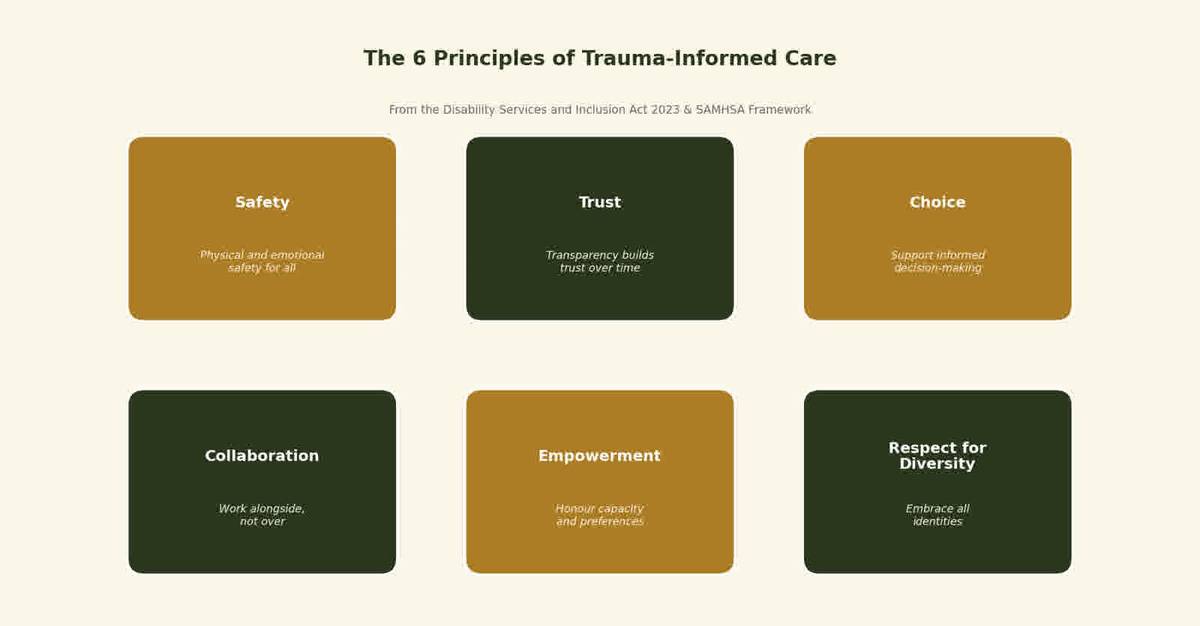
Safety
Physical and emotional safety must be the first priority. Environments should be predictable, calm, and free from the threat of harm or humiliation.
Trustworthiness
Services must be transparent and consistent. When workers do what they say they'll do, they build the trust that trauma often destroys.
Choice
People with disability must have genuine choices in all aspects of their support. Removing choice — even with good intentions — can re-traumatise.
Collaboration
Decisions are made with people, not for them. This includes planning, rostering, activity choices, and goal-setting. Power is shared, not held.
Empowerment
Services should build people's strengths and self-efficacy — not create dependency. Every interaction is an opportunity to reinforce that people are capable.
Respect for Diversity
Trauma affects people differently depending on their culture, gender, age, sexuality, and lived experience. One-size-fits-all approaches aren't good enough.
"Trauma-informed care asks us to stop seeing behaviour as a problem to fix and start seeing it as communication to understand."
— B-HART Framework for Rights-Based PracticeTraditional vs Trauma-Informed: The Real Difference in Practice
The gap between a traditional service approach and a trauma-informed one isn't always visible from the outside. It lives in the small interactions — how a worker responds when someone refuses support, how schedules are communicated, how conflict is handled. These micro-moments add up to either a culture of safety or one of re-traumatisation.
❌ Traditional Approach
- Focus on compliance: "You need to take your medication now."
- Behaviour seen as a problem to manage or extinguish
- Decisions made by professionals, often without meaningful consultation
- Restrictive practices used as a first response to distress
- Worker rotations without notice, creating instability
- Language centred on deficits and diagnoses
✅ Trauma-Informed Approach
- Focus on safety and agency: "When would you like to take your medication?"
- Behaviour seen as meaningful communication about unmet needs
- Decisions made collaboratively, with the person at the centre
- Proactive strategies to reduce distress before escalation occurs
- Consistent staffing and advance notice of any changes
- Language centred on strengths, goals, and capability

Understanding Behaviour as a Coping Mechanism
One of the most transformative ideas in trauma-informed practice is the reframing of what might be called "challenging behaviour". A person who becomes aggressive when their routine is changed without warning isn't being difficult — they may be responding to a genuine sense of threat, one rooted in past experiences where unpredictable change led to harm.
A person who hoards food, who refuses to be touched, who shuts down when asked a direct question — these patterns often developed as rational survival strategies. They may have worked in a previous context, even if they create friction in a service setting now. The trauma-informed approach is to recognise these patterns without judgement and to work with the person — slowly and respectfully — to develop new safety strategies where the old ones are no longer needed.
Practical reframe for support workers: The next time a participant's behaviour feels challenging or hard to understand, try asking yourself: "In what past experience might this response have made complete sense?" This single question can shift your entire approach — from reactive management to curious, compassionate understanding.
February 2026 research published in a Wiley disability journal has further strengthened the case for a disability-specific trauma-informed framework — one that goes beyond the generic clinical model and accounts for the unique forms of trauma that people with disability commonly experience, including service-related trauma, systemic discrimination, and repeated violations of autonomy.
How Trauma-Informed Care Fits Within the B-HART Framework
At B-HART, trauma-informed care isn't a standalone module or an add-on to existing training. It's one of four foundational pillars of the B-HART approach to rights-based disability practice. The other three are: the UN Convention on the Rights of Persons with Disabilities (read more about our UNCRPD approach), the Inner Development Goals (IDG) — which focus on the inner capacity of practitioners — and rights-based Positive Behaviour Support.
These four foundations work together. You can't truly practise trauma-informed care without also understanding human rights. You can't implement rights-based PBS without trauma-informed principles embedded in how you approach behaviour. And you can't sustain any of it without the inner development work that builds emotional regulation, empathy, and reflective practice in the people doing the work.
This integrated model is detailed in Supporting with Heart by Pouya Farbod, which outlines the evidence base for the B-HART approach. The book is a practical guide for disability sector workers, managers, and organisations wanting to genuinely shift their culture — not just update their policy documents.
"True rights-based practice doesn't happen in a policy document. It happens in the moment a worker pauses, chooses curiosity over reaction, and responds to a person's distress with dignity rather than control."
— B-HART Team
How to Implement Trauma-Informed Care in Your Organisation
Embedding trauma-informed practice isn't a one-day training exercise. It's a cultural and systemic shift that requires leadership commitment, workforce development, and ongoing reflection. Here's a practical pathway for disability service organisations at different stages of the journey.
Start with leadership awareness
Trauma-informed practice must be modelled from the top. Leaders who practise transparency, psychological safety, and shared decision-making with their teams create the conditions for trauma-informed service delivery. Staff who feel safe in their workplace are better equipped to make participants feel safe.
Audit your current environment and practices
Walk through your service from the perspective of someone who has experienced trauma. Are your environments calm and predictable? Do participants have genuine choice and control over their daily routines? Are restrictive practices being used proactively or reactively? Are workers trained to recognise and respond to trauma responses?
Train your entire workforce — not just frontline staff
Trauma-informed training is not just for direct support workers. Schedulers, administrators, managers, and HR staff all interact with participants in ways that can either reinforce or undermine safety. Training across the whole organisation ensures consistent, trauma-informed responses at every touchpoint. The NDIS Quality and Safeguards Commission provides guidance on minimum training standards.
Review your documentation and planning processes
How are participant profiles written? Do they lead with deficits and diagnoses, or with strengths, goals, and preferences? Are past traumatic events recorded sensitively and accessed only on a need-to-know basis? Does the planning process actively involve the person, or is it done about them?
Build in ongoing reflection and supervision
Trauma-informed practice is not a destination — it's a continuous process. Regular reflective supervision allows workers to process difficult experiences, identify their own trauma responses, and maintain empathy and professional boundaries. This is essential for preventing vicarious trauma and workforce burnout in disability services.
Seek certification and external accountability
B-HART's certification pathway provides a structured, externally validated process for organisations to demonstrate their commitment to rights-based, trauma-informed practice. Certification signals to participants, families, and funders that your organisation is serious about quality — and provides a framework for continuous improvement. Learn more about B-HART certification.
The Role of Workforce Culture in Trauma-Informed Services
You cannot build a trauma-informed service with a traumatised workforce. This is one of the most overlooked aspects of implementation — and one of the most important. Support workers in the disability sector often carry their own histories of trauma, and working with people who have experienced significant adversity can be emotionally demanding. Vicarious trauma, compassion fatigue, and burnout are real risks in this sector.
A truly trauma-informed organisation takes care of its people at every level. This means regular supervision and debriefing, clear role boundaries, workload management, psychological safety to speak up about concerns, and genuine recognition for the emotional labour involved in this work. When workers feel valued and safe, they bring their best selves to their participants.
For managers and team leaders: Check in with your team after difficult incidents — not just to document what happened, but to ask how people are feeling. A five-minute debrief that acknowledges the emotional weight of the work can make a significant difference to staff wellbeing and retention. This is trauma-informed leadership in practice.
Trauma-Informed NDIS Practice: What Participants and Families Should Know
If you're a person with disability, a family member, or an advocate navigating NDIS services, understanding trauma-informed practice can help you identify which providers are genuinely committed to quality — and which are not.
- Ask providers directly: "What does trauma-informed practice mean in your organisation, and how is it implemented day-to-day?"
- Look for services that involve participants in their own planning, rostering, and goal-setting
- Check whether workers are trained in trauma-informed approaches and whether training is ongoing
- Ask about restrictive practices policies — good providers minimise restrictions and use them only as a last resort
- Look for providers who can articulate their approach to behaviour support in strengths-based terms
- Seek providers with external certification or a documented rights-based framework
You can also explore B-HART's news and resources at b-hart.com.au/news for ongoing updates on rights-based and trauma-informed practice in the disability sector.
The term "trauma-informed care" was first developed in mental health settings in the 1990s, but its application to disability services is a more recent and significant development — one that's been accelerated by Australia's Disability Royal Commission and the landmark Disability Services and Inclusion Act 2023.
Key Takeaways
- Trauma-informed care is not therapy — it's an organisational approach to how services are designed, delivered, and governed
- The Disability Services and Inclusion Act 2023 makes trauma-informed practice a legal requirement for funded disability service providers
- The six SAMHSA principles — Safety, Trustworthiness, Choice, Collaboration, Empowerment, and Respect for Diversity — provide a practical framework
- Behaviours that might look "challenging" are often rational coping mechanisms rooted in past trauma — understanding the why changes everything
- Trauma-informed care is one of four foundations in the B-HART framework, alongside UNCRPD, Inner Development Goals, and rights-based PBS
- Implementing trauma-informed practice requires whole-of-organisation commitment — leadership, workforce, documentation, environment, and culture
- Caring for the workforce is inseparable from caring for participants — a traumatised workforce cannot deliver trauma-informed services
Frequently Asked Questions
What is trauma-informed care in disability services?
Trauma-informed care is an organisational approach that recognises the widespread impact of trauma and responds by integrating knowledge about trauma into policies, procedures, and practices. In disability services, it means designing supports so that people feel physically and emotionally safe, have genuine choice and control, and are treated with dignity and respect — especially given that people with disability experience trauma at significantly higher rates than the general population.
Is trauma-informed care required under the NDIS?
Yes. The Disability Services and Inclusion Act 2023 requires funded providers to embed trauma-informed practice into their service delivery. The NDIS Quality and Safeguards Commission also expects providers to demonstrate trauma-aware approaches in behaviour support and worker training. You can find guidance on compliance at the NDIS Quality and Safeguards Commission website.
Do support workers need to ask about a participant's trauma history?
No — and in most cases, they should not. Trauma-informed practice does not require workers to probe or elicit trauma disclosures. It requires workers to create conditions of safety, consistency, and choice that benefit everyone, regardless of their specific history. If a participant chooses to share their experiences, workers should respond with empathy and follow their organisation's protocols for support and documentation.
How is trauma-informed care different from person-centred practice?
They're complementary but distinct. Person-centred practice focuses on aligning supports with an individual's goals, preferences, and strengths. Trauma-informed care focuses on understanding how past adversity shapes a person's responses and needs, and on designing services that don't inadvertently cause further harm. Best-practice disability services incorporate both — with trauma-informed principles embedded into person-centred planning and delivery.
What is the B-HART framework and how does it relate to trauma-informed practice?
The B-HART framework is a comprehensive approach to rights-based disability practice developed by B-HART, a social enterprise based in Australia. Trauma-informed care is one of four foundational pillars, alongside the UN Convention on the Rights of Persons with Disabilities (UNCRPD), Inner Development Goals, and rights-based Positive Behaviour Support. The framework is designed to help organisations move beyond compliance toward genuine human rights practice. Learn more about the B-HART framework.
How long does it take to implement trauma-informed practice in a disability organisation?
Meaningful culture change typically takes one to three years, depending on the size of the organisation and where it's starting from. Initial training can be delivered in days, but embedding trauma-informed principles into every aspect of service delivery — from rostering to documentation to leadership practice — requires ongoing commitment, supervision, and review. B-HART's certification pathway offers a structured timeline and external accountability for organisations serious about this change.
Ready to Build a Genuinely Trauma-Informed Service?
B-HART supports disability organisations to move beyond compliance and into genuine rights-based, trauma-informed practice. Our certification pathway, training programs, and consulting services are built on evidence — and designed for real-world implementation.
Explore B-HART CertificationOr learn more about the B-HART framework and how it can transform your organisation's approach to disability practice. You can also browse our latest resources and news on rights-based practice.