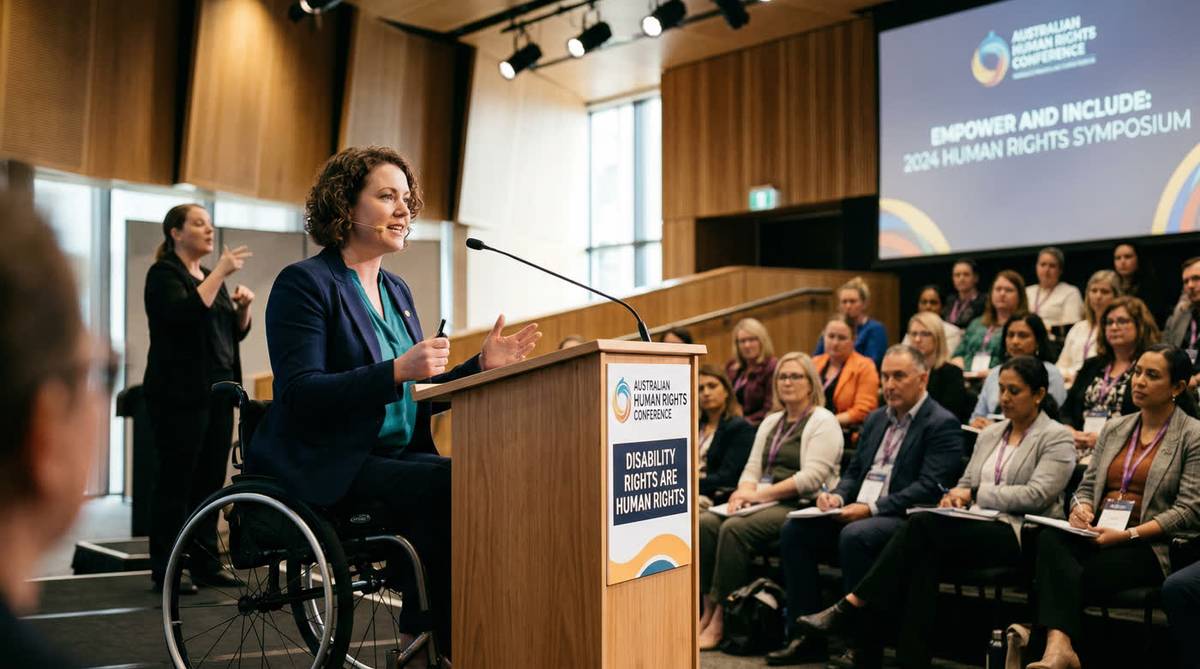
Human rights are not a compliance checkbox. They are the reason disability services exist. Australia's commitment to the UN Convention on the Rights of Persons with Disabilities (UNCRPD) — and Article 19 in particular — demands something deeper than paperwork: it demands that every person with disability can genuinely choose where they live, how they live, and who supports them. This post unpacks what Article 19 means, why it matters for service providers right now, and what a real Human Rights-Based Approach looks like in practice.

Plain language summary: A Human Rights-Based Approach (HRBA) means people with disability have real choice, real control, and real access — not just paperwork that says they do. Article 19 of the UNCRPD is the international standard that makes this a legal and moral obligation for Australia.
What Is Article 19 of the UNCRPD?
Article 19 — titled "Living Independently and Being Included in the Community" — is one of the most powerful articles in the UN Convention on the Rights of Persons with Disabilities. Ratified by Australia in 2008, it establishes three interconnected rights that apply to every person with disability, regardless of the complexity of their support needs.
Together, these three elements form the foundation of what it means to live a self-determined life. When any one of them is missing — when a person cannot choose their housemates, or cannot access their community without barriers, or when support is rationed to the point of isolation — Article 19 is not being honoured.
Australia was one of the first countries to ratify the UNCRPD in 2008. Yet the UN Committee on the Rights of Persons with Disabilities has repeatedly raised concerns about the ongoing use of restrictive practices and segregated settings in the Australian disability system. Ratification is the beginning, not the end, of the obligation.
Why Article 19 Matters for Disability Service Providers
It would be easy to read Article 19 as something directed only at governments — at policy-makers, legislators, and planners. But the practical weight of this article falls squarely on service providers. Every decision made in a support setting either advances or undermines Article 19. Who decides when the person wakes up? Who chooses the housemates? Who controls the support hours? Who designs the risk management plan — and does the person with disability have a genuine say in it?
The Australian Human Rights Commission is clear: the Disability Discrimination Act makes disability discrimination unlawful across public life, including in the provision of services. Failing to make reasonable adjustments — or designing services in ways that strip away choice and control — can constitute unlawful discrimination. This is not abstract legal theory. It is the daily operating environment of every NDIS registered provider in Australia.
"An organisation's foundational stance should be a commitment to human rights and to participants being subject to the least restrictive alternatives in all support practice."
NDIS Quality and Safeguards Commission, Practice Guide: Organisational Strategies to Reduce Restrictive PracticesThe NDIS Quality and Safeguards Commission has made human rights the centrepiece of its regulatory framework. Its practice guidance on reducing restrictive practices explicitly states that rights-based thinking is not supplementary — it is foundational. Providers who treat human rights as an add-on risk regulatory action, reputational damage, and — most critically — ongoing harm to the people they support.

Compliance vs. Human Rights: Understanding the Difference
Many providers genuinely believe they are honouring human rights because they are meeting their compliance obligations. These are not the same thing — and conflating them is one of the most common and consequential mistakes in the sector.
❌ Compliance-Only Approach
- Behaviour support plans are filed and reviewed on schedule
- Restrictive practices are registered and reported
- Staff complete mandatory training modules
- Incident reports are submitted within required timeframes
- Person-centred plans exist as documents
✅ Human Rights-Based Approach
- Behaviour support is grounded in understanding the person's communication and unmet needs
- The goal is elimination of restrictive practices, not just documentation
- Staff are coached and supported to navigate complex situations with dignity
- Incidents are reviewed as signals of systemic issues, not just individual failures
- The person with disability is a co-author of their own plan
Compliance sets the floor. A Human Rights-Based Approach raises the ceiling. The difference is not just philosophical — it shows up in outcomes: fewer incidents, fewer restrictions, better staff retention, higher participant satisfaction, and stronger organisational resilience under scrutiny.
Article 19 in Practice: What the Data Tells Us
The gap between a rights-based approach and a compliance-only approach is measurable across the three pillars of Article 19. Organisations that actively embed human rights into governance, workforce development, and service design consistently outperform those that treat compliance as the destination.
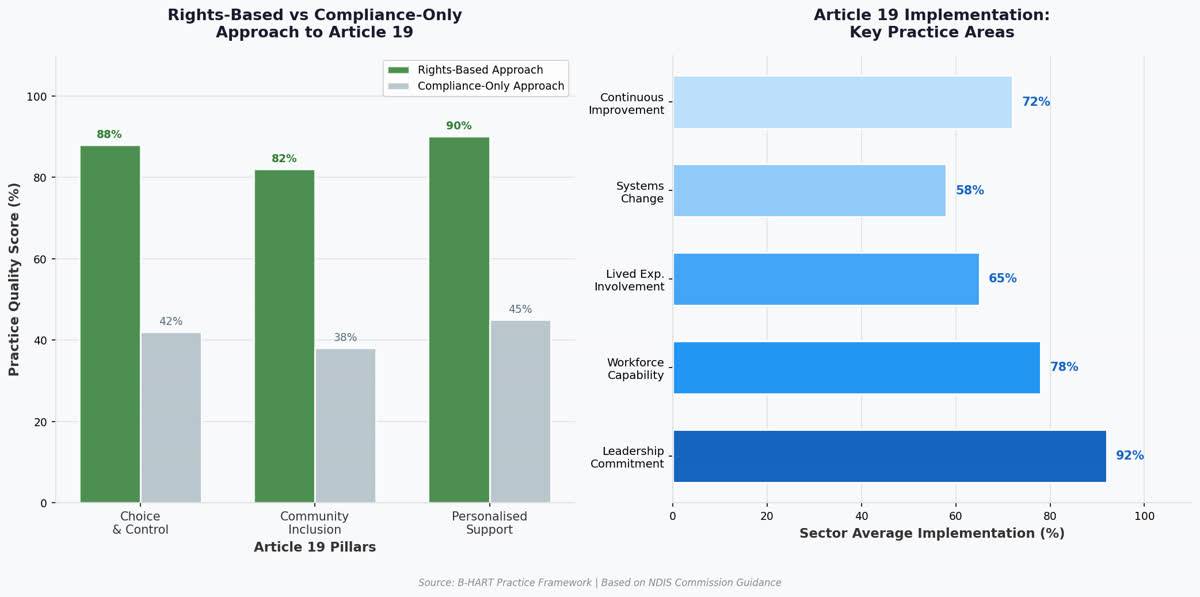
Watch out: The most common failure point is the gap between written policy and lived experience. Many organisations have excellent human rights language in their policies — but when you ask the people they support whether they feel in control of their lives, the answers tell a different story. Policy without practice is not a Human Rights-Based Approach.
Five Organisational Focus Areas for Rights-Based Practice
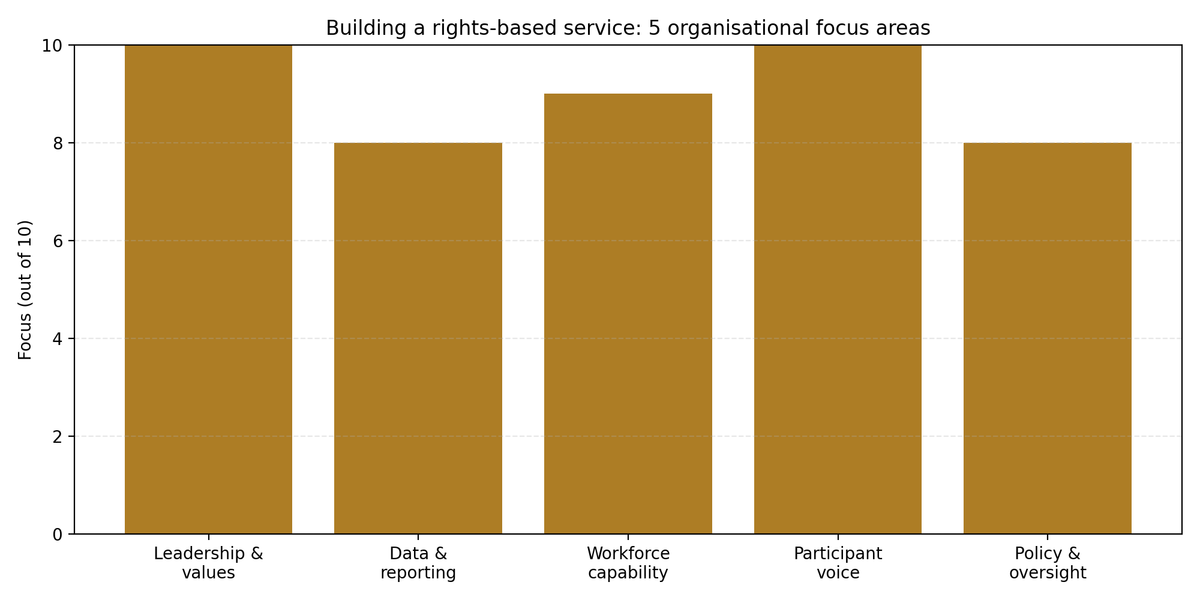
Based on themes in the NDIS Commission's practice guidance and B-HART's work across the sector, there are five organisational focus areas that reliably predict whether a service is genuinely rights-based or merely compliant.
Leadership Commitment
Rights-based practice starts at the top. When boards and executives hold human rights as a genuine organisational value — not just a regulatory requirement — the whole system orients around it.
Workforce Capability
Staff need more than awareness training. They need practical skills in supported decision-making, communication, dignity of risk, and managing complex situations without resorting to restriction.
Lived Experience Involvement
People with disability should be genuine co-designers of service models, governance structures, and quality review processes — not consulted at the end of a process that has already been decided.
Systems and Environment Design
Rights are often blocked by environments, rosters, and processes — not by individual attitudes. Changing systems so that the rights-respecting option is also the easiest option is essential work.
Data and Transparency
Using data — incidents, complaints, restriction reports, feedback — to identify patterns and drive improvement is a hallmark of a mature rights-based organisation. Transparency builds trust and accountability.
A Step-by-Step Guide to Embedding HRBA in Your Organisation
Embedding a Human Rights-Based Approach is not a single project with a start and end date. It is a continuous journey. But there are clear steps that mark the path, and knowing where you are in that journey helps you work out what to do next.
Establish Leadership Commitment
Secure a genuine, documented commitment from the board and executive leadership that human rights — not just compliance — is the organisational standard. This shapes resourcing decisions, governance priorities, and the culture that follows. Without it, everything else is fragile.
Conduct a Baseline Review
Audit your current practices against Article 19 and the NDIS Practice Standards. Where are people genuinely exercising choice and control? Where are restrictions used routinely rather than as a last resort? Where is lived experience absent from decision-making? The baseline tells you where to focus.
Invest in Workforce Capability
Train and coach staff to support communication, facilitated decision-making, and dignity of risk. Focus on practical skills — what does a support worker do when a person makes a choice that others consider risky? How do you hold the tension between safety and autonomy? This is where HRBA lives or dies on the floor.
Bring Lived Experience into Governance
Create genuine pathways for people with disability to influence governance, service design, and quality review. This means paid roles, accessible formats, and decision-making power — not just consultation that happens after the key decisions have been made.
Use Data to Find and Address Patterns
Look for where restrictions, complaints, incidents, and staff turnover cluster. These are signals of systemic issues, not just individual failures. Use that data to drive targeted improvement — change environments, redesign rostering, review processes so the rights-respecting option is the path of least resistance.
Build Feedback Loops and Continuous Improvement
Human rights practice is never "done." Create structured mechanisms for ongoing feedback from people with disability, families, and staff. Report transparently on progress. Hold yourself accountable to improvement over time, and celebrate the wins along the way.
How Change Typically Unfolds: A Timeline
Foundation Setting
Leadership commitment secured and documented. Baseline review initiated. Priority practice areas identified based on incident data, lived experience feedback, and compliance history.
Workforce and Pilot Work
Rights-based workforce learning rolled out. Practical tools — supported decision-making frameworks, least restrictive practice guides — piloted in one service area. Early feedback loops established.
Systems and Governance Integration
Governance reporting updated to include human rights indicators. Lived experience feedback mechanisms formalised. Pilot learnings used to refine tools for broader rollout across the organisation.
Continuous Improvement and Transparency
Regular review cycles, transparent reporting, and strengthening safeguards as the organisation matures. Human rights becomes embedded in culture — not just in policy documents.
What Rights-Based Practice Looks Like for People
It is easy to talk about human rights in abstract terms. It is more powerful to talk about what it actually looks, feels, and sounds like for the people being supported. Here is what changes when Article 19 is genuinely honoured.
- A person chooses their housemates and has a real say in how the household is run
- Mealtimes, bedtimes, and routines reflect what the person wants — not what is convenient for the roster
- Support workers are trained to facilitate communication, not to speak on behalf of the person
- Risk is understood as something to be navigated with the person, not used as a reason to restrict their choices
- Community participation is a regular part of a person's week — not an occasional outing
- A person's goals, preferences, and feedback drive their support plan, and changes are made when things are not working
- Staff treat the person with the same dignity and respect they would want for themselves or their family
And here is what it looks like when Article 19 is not being honoured — even in services that appear compliant on paper.
- Decisions about where and how a person lives are made by staff or family without the person's meaningful input
- Restrictive practices are in place not because of assessed need but because of staff comfort or organisational convenience
- The person has no way to raise concerns, or has tried and nothing has changed
- Community access is restricted due to staffing shortages or risk aversion
- The person's cultural identity, language, and individual preferences are not reflected in how support is delivered
- Staff turnover is so high that the person is constantly building trust with new workers
Practical tip: One of the most powerful tools for any organisation is simply asking people with disability — in accessible, supported ways — "Do you feel in control of your life?" and then taking the answer seriously. The gap between what organisations believe and what people experience is where the work is.
Frequently Asked Questions
Frequently Asked Questions
Is a Human Rights-Based Approach the same as being NDIS compliant?
No. Compliance is the minimum standard required to operate. A Human Rights-Based Approach goes further — it is about the culture, values, and practical decision-making that shapes what life is actually like for the people you support. An organisation can be fully compliant on paper while still systematically undermining the choice and autonomy of the people it serves.
How does HRBA relate to restrictive practices?
A rights-based approach reframes restrictive practices entirely. Rather than asking "is this restriction documented and reported?", it asks "how do we understand and respond to this person's needs in a way that avoids restriction altogether?" The goal is not compliance with reporting requirements — it is genuine reduction and eventual elimination of restrictive practices through better understanding, environment design, and workforce capability.
Where can I read the NDIS Commission guidance on rights-based practice?
The NDIS Quality and Safeguards Commission has published detailed practice guides on organisational approaches to reducing restrictive practices, active support, and rights-based service delivery. These are essential reading for any provider leadership team.
Does Article 19 apply even to people with very high support needs?
Yes, unequivocally. Article 19 explicitly states that these rights apply to "all persons with disabilities." The obligation to provide sufficient supports so that people with high and complex support needs can exercise choice and community inclusion is actually greater — not lesser — for those whose autonomy is most at risk of being overridden.
How long does it take to embed a Human Rights-Based Approach?
Culture change takes time — typically 18 to 24 months before you see sustained, systemic change across an organisation. But early wins are possible within weeks. Starting with leadership commitment, a baseline review, and focused workforce development in one area can produce meaningful improvements in months, not years.
What is B-HART's role in supporting providers on this journey?
B-HART provides practical, evidence-based support to organisations wanting to embed genuine human rights practice — including certification frameworks, workforce capability programs, governance reviews, and lived experience integration. Learn about B-HART certification or get in touch to discuss your organisation's needs.
Key Takeaways
Key Takeaways
- Article 19 of the UNCRPD guarantees people with disability the right to choose where and with whom they live, access personalised community supports, and participate in community life on an equal basis with others.
- Australia ratified the UNCRPD in 2008 — that commitment belongs not just to governments but to every registered disability service provider.
- Compliance and a Human Rights-Based Approach are not the same thing. Compliance sets the floor; rights-based practice raises the ceiling.
- The NDIS Commission places human rights at the foundation of its regulatory framework — organisations that treat it as optional face both regulatory and reputational risk.
- Real change requires leadership commitment, workforce capability, lived experience involvement, systems redesign, and data-driven continuous improvement — working together.
- B-HART helps organisations move from compliance to genuine rights-based practice through structured, practical support.
Ready to Embed Human Rights in Your Services?
If you are a provider, leader, or quality team who wants to move beyond compliance and genuinely embed Article 19 into everyday practice, B-HART has the frameworks, tools, and expertise to help. Our certification program gives organisations a structured, credible pathway to rights-based practice — recognised across the sector.
Get B-HART CertifiedOr get in touch to learn more about how we can support your organisation's human rights journey.