
Rights-based practice for disability support workers isn't about ticking boxes on a compliance checklist — it's about how you show up in every conversation, every meal-time decision, and every moment of someone's day. When you understand what genuine rights-based practice looks like in action, your work transforms from task delivery into something far more powerful: real partnership with the people you support.
What the UNCRPD Actually Means for Your Work
The United Nations Convention on the Rights of Persons with Disabilities (UNCRPD) is not an abstract international document — it is the legal and ethical foundation that shapes everything disability support workers do in Australia. Australia ratified the convention in 2008, committing to uphold the rights of people with disability in law and in practice.
At its heart, the UNCRPD shifts the framing from a charity or medical model — where disability is a problem to be fixed — to a human rights model, where people with disability are rights-holders entitled to full participation in society. Article 19 guarantees the right to live independently and be included in the community. Article 12 protects equal recognition before the law and the right to make your own decisions. Article 25 protects the right to the highest attainable standard of health without discrimination.
As a support worker, these articles are not just policy words. They are the reason why you ask before you act, why you offer choices rather than make assumptions, and why you advocate when a person's voice is being overridden. The NDIS Quality and Safeguards Commission expects all registered providers and their workers to embed these rights in everyday practice — not just understand them conceptually.
The UNCRPD in plain language: People with disability have the same human rights as everyone else — including the right to make choices, take risks, build relationships, and live the life they want. Your role as a support worker is to enable those rights, not manage them on someone else's behalf.
The Shift from Compliance to Genuine Rights
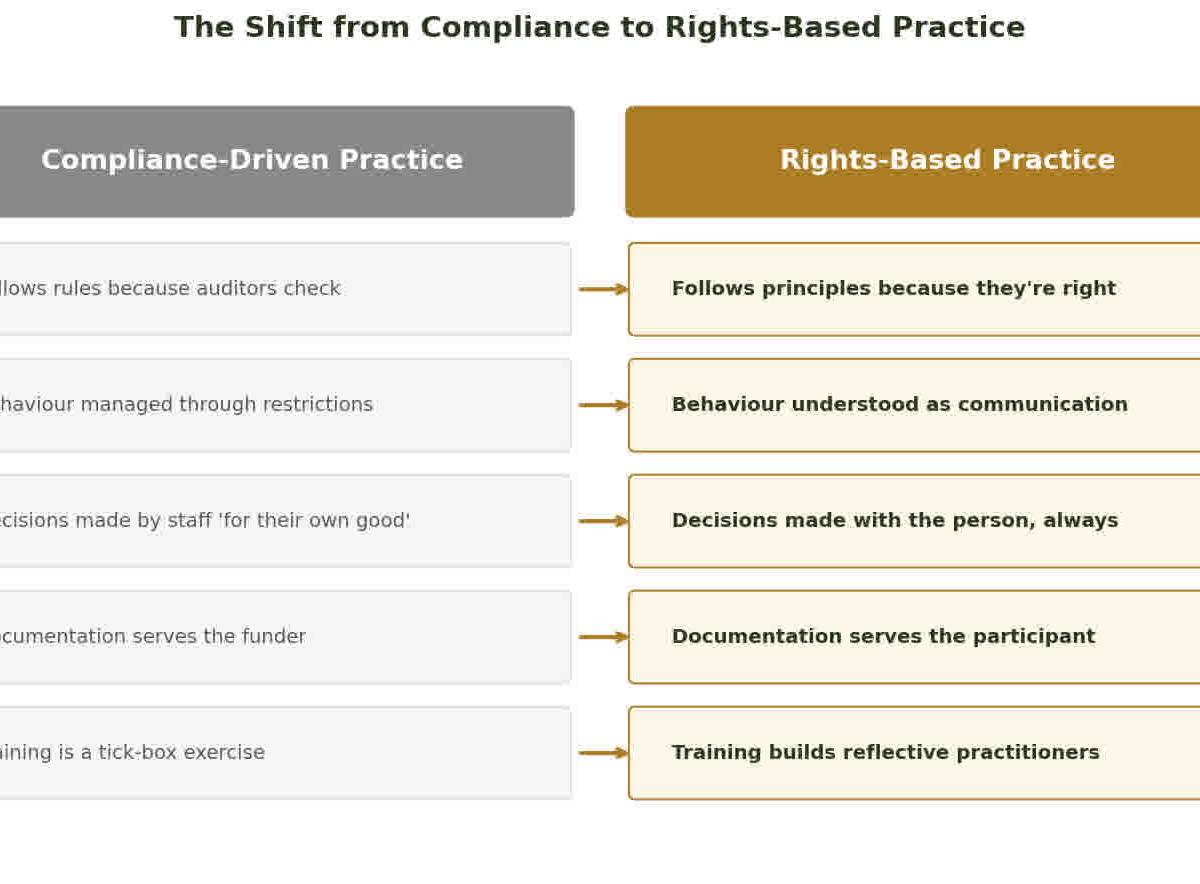
Many support workers are taught about rights-based practice through the lens of compliance — sign the consent form, follow the behaviour support plan, document the incident. These processes exist for important reasons, but compliance alone does not create a rights-respecting environment. True rights-based practice is an orientation, not a procedure.
Consider the difference between these two approaches. In a compliance mindset, a support worker arrives at 7am, follows the morning routine outlined in the care plan, and notes that tasks were completed. In a rights-based mindset, the same worker asks: "What does a good morning look like for you today?" and adapts accordingly. The paperwork may look identical — but the lived experience for the person is completely different.
- Follows care plan tasks sequentially
- Makes decisions to ensure safety and efficiency
- Asks "can I?" rather than "what do you want?"
- Documents completion of tasks
- Manages risk by reducing choice
- Uses care plan as a guide, not a script
- Supports the person to make their own decisions
- Asks "what matters to you today?"
- Documents what the person achieved and chose
- Manages risk alongside the person, not for them
The B-HART framework — which underpins the training in Supporting with Heart — makes this distinction central to everything. Rights-based practice is not about doing more paperwork or following additional procedures. It is about a genuine shift in how you see your role: as a supporter of someone else's life, not the manager of it. When you join the B-HART community through B-HART's certified training program, this shift in perspective is at the core of everything you learn.

Micro-Moments: Where Rights-Based Practice Actually Lives
Rights are not only enacted in planning meetings or formal decision-making processes. They are enacted in the small, everyday moments that make up a person's life. These "micro-moments" are where the philosophy meets reality — and where the quality of your practice has the greatest impact on how someone experiences their day.
Meal Time and Food Choices
Food is deeply personal. Cultural background, sensory preferences, health conditions, and simple likes and dislikes all shape what someone wants to eat. Yet mealtimes are one of the most common places where choice is quietly removed — when meals are prepared according to what is easy or nutritious rather than what the person actually wants.
A rights-based approach means involving the person in grocery planning, asking about preferences before the shopping is done, and preparing food that reflects their identity — not just their dietary requirements. Even when someone communicates differently, there are always ways to involve them: picture boards, digital menus, familiar routines they've established over time.
Activity Planning and Community Participation
Activity plans should reflect what the person values, not what the schedule allows. This means genuinely exploring what someone enjoys — even if those interests take more effort to support — and following through. It means not defaulting to the same community activities week after week because they are familiar and easy to manage.
Ask "What would you like to do this week?" rather than presenting a fixed list. Notice what someone gravitates toward and what they consistently avoid. Bring those observations into support meetings and plan reviews. This kind of attentive, curious practice is what Supporting with Heart describes as building a "living knowledge" of the person you support.
Communication and Information Access
People have the right to information that helps them make decisions — and the right to receive that information in a format they can actually access. This means using Easy Read documents when appropriate, speaking in plain language rather than sector jargon, and never having conversations about someone in front of them as though they cannot hear or understand.
Practical tip: Before discussing support plans with a parent, guardian, or coordinator while the person is present, always check in with the person first: "Is it okay if we talk about your supports now?" This small act of consent acknowledges their right to be part of conversations about their own life.
When Safety and Autonomy Conflict
One of the most challenging aspects of rights-based practice is navigating situations where a person's choice involves risk. This tension is real — and it is one that every thoughtful support worker grapples with. The instinct to protect can easily slide into paternalism if it is not grounded in a clear understanding of the person's rights.
The NDIS Commission's approach, and the B-HART framework, both recognise that dignity of risk — the right to make choices that involve some risk — is fundamental to a full and self-directed life. A person who is never allowed to take risks is being denied something essential: the experience of agency, consequence, and learning.
Risk vs rights — getting the balance right: "Duty of care" does not mean eliminating all risk. It means ensuring the person has the information they need to make an informed choice, that you have explored safer alternatives, and that you document the conversation honestly. It does not mean overriding the person's decision because you disagree with it.
A Framework for Navigating Risk and Choice
When a situation arises where safety and autonomy feel like they are in conflict, a structured approach helps you think clearly and act ethically.
What exactly does the person want to do? Do they understand the potential risks? Have they made this choice before? Understanding the full context before responding avoids reactive decision-making.
Provide the person with accurate, accessible information about the risks involved. "I want to make sure you know that [X] could happen — what do you think about that?" is very different from "You can't do that because it's dangerous."
Are there ways to support the person to do what they want more safely? Could you reduce a particular risk without eliminating the activity entirely? Collaborate on solutions rather than imposing restrictions.
Record that the person was informed, what information was shared, what they decided, and how you will support them. Good documentation protects everyone and demonstrates genuine engagement with the person's rights.
Escalation to a supervisor or coordinator is appropriate when there is an imminent risk of serious harm, not simply when you disagree with a choice. Know your organisation's escalation pathways — and the difference between a legal obligation to act and a personal discomfort with someone's decision.
Reflective Practice: The Tool That Keeps Rights Alive
Rights-based practice is not a destination — it is an ongoing practice that requires regular, honest self-reflection. The B-HART framework places reflective practice at the centre of professional development, recognising that awareness of your own assumptions, biases, and habits is essential to genuinely rights-respecting work.
Reflective practice means asking yourself hard questions: Was I truly offering a choice, or was I leading toward the outcome I preferred? Did I give this person enough time to respond, or did I jump in with my own suggestion? Did I treat that family member's opinion as more valid than the person's? These questions are uncomfortable — but they are how growth happens.
"The most powerful thing a support worker can do is stay curious — curious about who this person is, what they value, and how your presence either expands or narrows their world."
— B-HART framework, Supporting with HeartBuilding a Reflective Practice Habit
Reflective practice does not require lengthy journaling sessions or formal supervision every week — though both of those help. It can be as simple as a few questions you ask yourself at the end of each shift. Building this habit consistently, across all your shifts, is what separates workers who grow from workers who plateau.
- At the end of each shift, name one moment where you supported someone's choice — and one where you could have done better
- In team meetings, share a situation where rights and safety felt in tension — and explore how others would have handled it
- Read back through your recent progress notes and ask: do these notes centre the person's perspective, or just your observations?
- Seek out peer feedback — ask a trusted colleague to observe a shift and give honest input on your approach
- Keep a personal learning log linked to your B-HART certification portfolio, noting key moments and your developing understanding
Rights-Based Practice in Different Support Contexts
Rights-based practice looks different across different support environments — but its core commitments remain constant. Whether you work in supported independent living, community access, or in-home support, the same underlying respect for autonomy, dignity, and self-determination applies.
In someone's home, every decision about how spaces are organised, who visits, and how routines unfold is theirs to make. Your role is to support — not to impose household norms that belong to you.
Public settings present unique rights considerations: privacy, the right to interact without you hovering, and freedom from physical proximity that feels controlling or infantilising.
When supporting someone who uses AAC or other communication aids, patience is a rights issue — rushing communication cuts off someone's ability to exercise their voice.
Support plan reviews, NDIS planning meetings, and service negotiations are moments where workers can actively amplify the person's voice — or allow it to be drowned out.
Connecting Rights-Based Practice to the B-HART Framework
The B-HART certification program was built on the understanding that training must go beyond knowledge to change behaviour — and that rights-based practice is an identity shift, not just a skill set. The B-HART framework integrates rights-based principles with trauma-informed care, reflective practice, and strengths-based approaches to create a coherent model for high-quality support work.
Supporting with Heart, the foundational text of the B-HART curriculum, describes rights-based practice not as a set of rules to follow but as a way of seeing: recognising the person in front of you as a full human being whose life belongs to them. This framing — warm, clear, and deeply practical — is what sets B-HART certified workers apart in the sector.
If you have not yet explored what B-HART certification involves, learn more about the B-HART program and how it can shape your practice. You can also explore related content on our B-HART news and resources hub, including our guides on trauma-informed care in disability services and why B-HART certification matters for providers and participants.
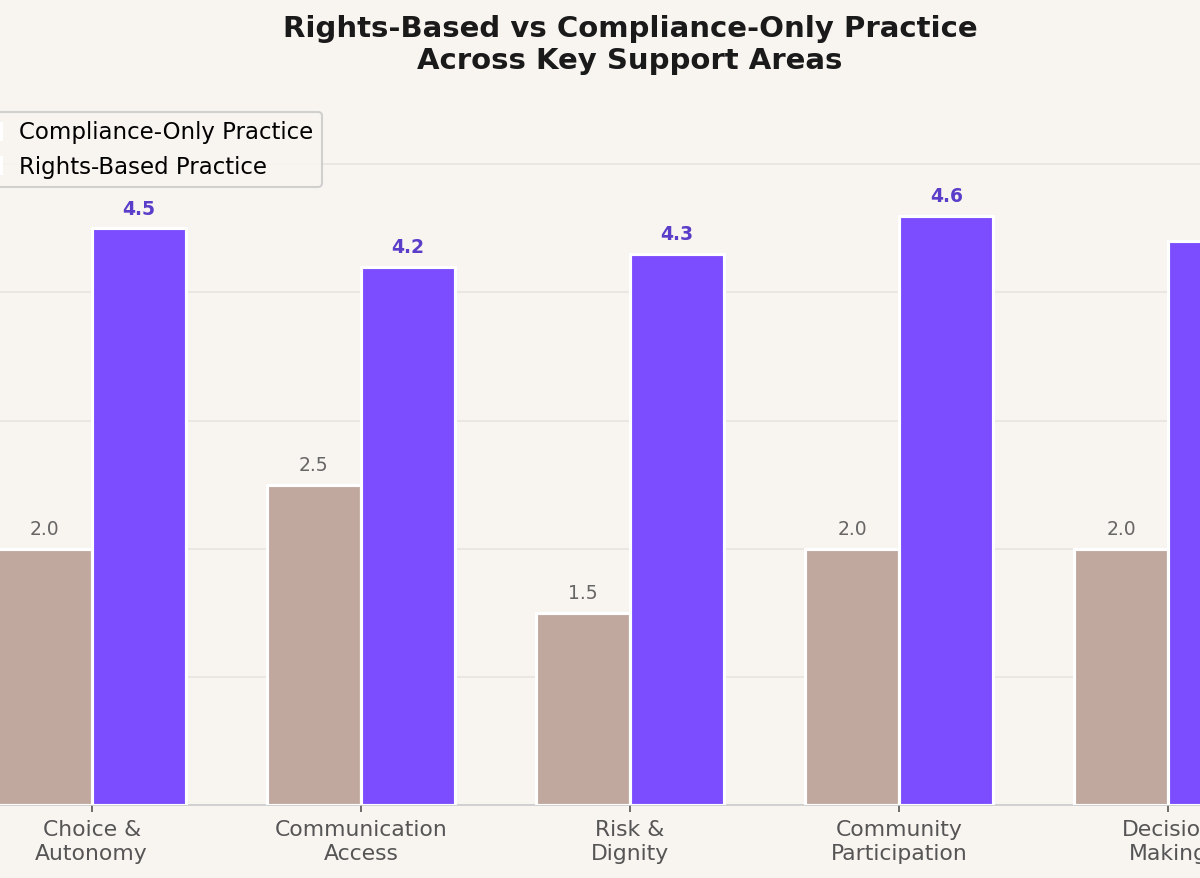
Research consistently shows that people with disability who experience genuine autonomy in their daily lives report significantly higher wellbeing outcomes — not just satisfaction with services, but improved mental health, stronger community connections, and greater confidence in their own decision-making.
Key Takeaways
- Rights-based practice for disability support workers is grounded in the UNCRPD — a legally binding framework that Australia has ratified and that shapes the NDIS Quality and Safeguards Commission's expectations of all providers
- The shift from compliance to genuine rights is a mindset change: from completing tasks to supporting a person's self-determined life
- Micro-moments — meal choices, activity planning, communication — are where rights-based practice is most powerfully expressed every day
- Dignity of risk is a real right: supporting someone to make choices that involve risk is part of genuine rights-based practice, not a failure of duty of care
- Reflective practice is what keeps rights alive over time — regularly examining your assumptions and habits is how you keep growing as a support worker
- The B-HART framework and Supporting with Heart provide the practical tools and professional grounding to embed these principles into daily work
Frequently Asked Questions
What is rights-based practice in disability support?
Rights-based practice means treating people with disability as rights-holders — not as recipients of charity or patients to be managed. It involves recognising and actively supporting each person's right to make decisions about their own life, receive accessible information, participate in their community, and be treated with dignity and respect. It is grounded in the United Nations Convention on the Rights of Persons with Disabilities.
How does rights-based practice differ from person-centred care?
Person-centred care focuses on tailoring support to individual preferences and needs. Rights-based practice goes further — it positions the person not just as the focus of support, but as a rights-holder with entitlements that must be actively upheld. While person-centred care asks "what does this person need?", rights-based practice asks "how do I ensure this person's rights are not being compromised?" The two approaches are complementary and work best together.
What should I do if I disagree with a person's choice as their support worker?
Your role is to provide information, not to override decisions. Share your concern clearly and respectfully, ensure the person has the information needed to make an informed choice, and explore whether there are alternatives that reduce risk while still respecting their autonomy. Unless the choice involves an imminent legal obligation to act, the decision is theirs to make — even if you would choose differently. Document the conversation carefully, and discuss it with your supervisor if you remain uncertain.
How does the NDIS Commission expect support workers to apply rights-based practice?
The NDIS Quality and Safeguards Commission requires all registered providers to deliver supports in a way that upholds the rights of people with disability — including their right to make decisions, access information, and be free from abuse, neglect, and exploitation. Workers are expected to understand and apply the NDIS Code of Conduct, which includes acting with respect, providing supports that are safe and competent, and fostering independence and community participation.
How does B-HART training help support workers develop rights-based practice?
B-HART certification takes a whole-person approach to professional development — integrating rights-based practice with trauma-informed care, reflective practice, and strengths-based support. The Supporting with Heart framework gives workers practical language and tools to embed rights into everyday interactions, not just formal procedures. Learn more about why B-HART certification matters for the people you support.
Ready to Strengthen Your Rights-Based Practice?
B-HART certification gives disability support workers the practical skills, reflective tools, and professional grounding to deliver genuinely rights-respecting support every day.
Explore B-HART CertificationAlready certified? Stay connected with the latest resources and sector insights on the B-HART news hub.
- United Nations Convention on the Rights of Persons with Disabilities (OHCHR)
- NDIS Quality and Safeguards Commission — Code of Conduct and Practice Standards
- B-HART Framework and Certification Program
- B-HART: Trauma-Informed Care in Disability Services
- B-HART: Why B-HART Certification Matters for Providers and Participants