
B-HART certification is changing what it means to be a quality disability service provider in Australia. It's not a compliance checkbox or a logo to add to your website — it's a genuine, ongoing commitment to human rights practice that participants can feel, families can trust, and workforces can believe in. This guide explains what B-HART certification is, how it works, and why it matters for providers and the people they support.

What B-HART Certification Actually Is
The B-HART framework — Behaviour Human Rights Tool — was developed to help disability service providers move beyond minimum compliance and into genuine rights-based practice. At its heart, B-HART certification signals that an organisation doesn't just follow the rules: it actively upholds the human rights of every person with disability it supports, as set out in the United Nations Convention on the Rights of Persons with Disabilities (UNCRPD).
The certification process was shaped by the work of Pouya Farbod, whose book Supporting with Heart laid much of the philosophical groundwork for what the framework has become. Farbod's central argument — that genuine support requires inner transformation, not just skill acquisition — runs through every element of B-HART. You can't support someone's rights if you don't truly understand what those rights are, or if your organisation's culture quietly undermines them.
B-HART certification means your organisation has done the inner and outer work: understood the framework, applied it consistently, reflected on practice, and committed to continuous improvement. It's a living credential, not a historical record.
What B-HART stands for: Behaviour Human Rights Tool. It's a framework and certification pathway for disability service providers who want to embed human rights practice — not just human rights language — into their organisations. Learn more on the B-HART About page.
The Four Foundations of the B-HART Framework
B-HART certification isn't built on a single idea. It rests on four interconnected foundations, each one chosen because it addresses a different dimension of what rights-based disability support actually requires.
UNCRPD
The United Nations Convention on the Rights of Persons with Disabilities is the international human rights treaty that defines what Australia has committed to. B-HART grounds all practice in UNCRPD articles — particularly around autonomy, inclusion, and freedom from abuse.
Inner Development Goals (IDGs)
The IDGs are a framework for the skills and qualities that people need to create meaningful change. B-HART uses them to support support workers and leaders to develop the inner capacities — empathy, self-awareness, courage — that rights-based practice genuinely requires.
Rights-Based Positive Behaviour Support
Rights-based PBS reframes behaviour support entirely: instead of focusing on managing or eliminating behaviour, it asks what unmet rights or needs the behaviour is communicating. This approach is non-punitive, dignity-centred, and built on genuine partnership with the person.
Trauma-Informed Care
Many people with disability have experienced significant trauma — including through the very services meant to help them. Trauma-informed care means understanding how trauma shapes behaviour and interaction, and responding in ways that build safety rather than re-trigger harm. Read our deep dive on trauma-informed care in disability services for more detail.
These four foundations work together. You can't apply rights-based PBS effectively without trauma-informed awareness. You can't develop the IDGs without reflecting on how UNCRPD principles show up (or don't) in your daily work. B-HART certification asks providers to demonstrate competency across all four — and to keep building on them.
What Providers Gain from B-HART Certification
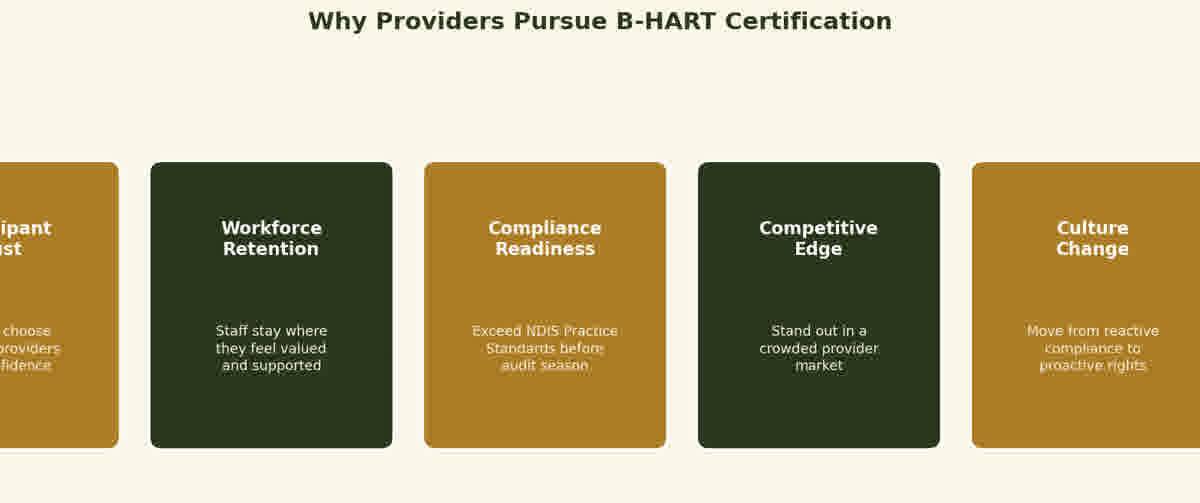
There are real, practical benefits to pursuing B-HART certification — benefits that go well beyond having a badge to display. Providers who have gone through the process describe changes that reach into how their organisations feel to work in, and how participants experience their support.
Participant Trust and Relationships
People with disability and their families are increasingly sophisticated in how they evaluate providers. NDIS registration tells them a provider meets minimum standards. B-HART certification tells them something different: that this provider has made a deliberate, evidenced choice to operate according to human rights principles. That's a meaningful differentiator, and participants notice it.
Trust builds faster when participants can see that staff understand rights, listen genuinely, and respond to the whole person — not just the task list in the support plan. B-HART-certified providers invest in developing this capacity across their workforce.
Workforce Retention and Culture Change
The disability sector has a workforce retention crisis. Many support workers leave within their first two years, citing poor organisational culture, lack of professional development, and feeling that their work doesn't make a meaningful difference. B-HART certification directly addresses these drivers.
Organisations that embed the Inner Development Goals and reflective practice into their culture give workers something to grow into. They create environments where workers feel supported to be more than task-completers. Staff who understand rights-based PBS feel less reactive and more confident in complex situations. The result is a workforce that stays, and that attracts more of the same.

Compliance Readiness and Future-Proofing
The NDIS landscape is shifting towards higher expectations of provider quality, particularly around restrictive practice reduction and rights-based outcomes. The NDIS Quality and Safeguards Commission is strengthening its focus on participant outcomes, not just process compliance.
B-HART-certified providers are ahead of this curve. When the Commission looks at how providers manage behaviour support, respond to incidents, and involve participants in decisions, B-HART-trained organisations have documented evidence of rights-based practice baked into their culture — not assembled at audit time.
Read our post on beyond compliance: NDIS 2026 reforms and human rights for more context on where the sector is heading.
For providers preparing for NDIS registration renewal or Commission reviews: B-HART certification doesn't replace the Commission's requirements, but the evidence your organisation builds through the certification process — reflective practice records, rights audits, staff development documentation — directly supports your compliance documentation.
Competitive Edge in a Crowded Market
There are thousands of NDIS registered providers across Australia. Most of them can claim they're "person-centred" and "quality-focused". Very few can point to verified certification under a specific, evidence-based human rights framework. B-HART certification is a differentiator that's hard to fake and impossible to claim without having done the work.
For providers seeking referrals from support coordinators, plan managers, and LACs, B-HART certification is a credible signal that stands out in a market saturated with generic quality claims.
"Rights aren't a bonus in disability support — they're the baseline. B-HART certification is how providers show they understand that."
— B-HART TeamWhat Participants Gain — The Lived Difference
For the people receiving support, B-HART certification isn't an abstract credential. It shows up in the texture of everyday interactions — and in the big moments where rights either get protected or get overridden.
In practice, this means support workers who understand what self-determination actually looks like (and don't override it "for the person's own good"). It means behaviour support plans that start from a rights assessment, not a risk management template. It means being supported to communicate your preferences — however you communicate — and having those preferences genuinely acted on.
It also means working with an organisation that sees its role as building the conditions for your best life, not managing your disability. That distinction sounds philosophical, but participants feel it immediately. It's the difference between support that opens doors and support that patrols them.
The UNCRPD — which underpins the B-HART framework — has been ratified by Australia since 2008. Yet many disability service providers still operate without a structured process for checking whether their practice actually aligns with Australia's UNCRPD obligations. B-HART certification closes that gap.
B-HART Certification vs NDIS Registration — Understanding the Difference
A common question from providers is: "We're already NDIS registered. Why do we need B-HART certification?" The short answer is that they're doing different things. They're complementary, not competing.
| Dimension | NDIS Registration | B-HART Certification |
|---|---|---|
| What it measures | Minimum standards compliance (financial, operational, safeguards) | Active human rights practice embedded in culture and service delivery |
| Who requires it | NDIS Quality and Safeguards Commission — mandatory for most providers | Voluntary — chosen by providers committed to rights-based practice |
| Focus area | Process, documentation, financial management, incident reporting | Values, culture, participant rights, workforce development, reflective practice |
| Renewal model | Audit-based at set intervals | Ongoing pathway — continuous improvement, not a one-off pass/fail |
| What it signals to participants | "This provider meets the legal minimum to operate" | "This provider has chosen to hold itself to a higher standard" |
NDIS registration and B-HART certification work best together. Registration gives participants the protection of regulatory oversight. B-HART certification gives them the confidence that the provider's culture, not just its paperwork, is genuinely aligned with their rights.
How the B-HART Certification Pathway Works
B-HART certification is deliberately structured as a pathway rather than a one-off audit. This reflects a core belief: that rights-based practice is never "done". It's developed, practised, reflected on, and continuously improved. The certification process is designed to support that kind of ongoing growth.
Framework Engagement
Organisations begin by engaging deeply with the four B-HART foundations — UNCRPD, Inner Development Goals, rights-based PBS, and trauma-informed care. This isn't a passive read-through. It involves structured learning, team discussion, and self-assessment against the framework.
Practice Audit and Reflection
Providers conduct an honest assessment of current practice against the B-HART framework. Where are rights being genuinely upheld? Where are there gaps — in policy, in day-to-day interactions, in workforce knowledge? This reflective process is guided, not self-serving.
Development and Implementation
Organisations develop and implement changes — to policies, practices, workforce development, and organisational culture — that bring them into genuine alignment with the framework. B-HART provides guidance and support through this stage.
Certification and Ongoing Commitment
Once certified, organisations don't simply move on. B-HART certification requires ongoing reflective practice, continued development, and periodic re-engagement with the framework as practice evolves and participants' needs and rights are better understood.
The "Supporting with Heart" Foundation
Pouya Farbod's book Supporting with Heart sits at the centre of what B-HART represents. Farbod's work argues that effective disability support isn't primarily a technical skill — it's a relational and moral practice. The qualities that make someone a genuinely good support worker — empathy, curiosity, respect for autonomy, willingness to be uncomfortable — can't be taught through compliance training alone.
This is why the Inner Development Goals feature so prominently in the B-HART framework. The IDGs name and develop the inner capacities that rights-based support actually requires: the ability to see each person in their full humanity, to hold uncertainty without rushing to fix, and to advocate for someone's rights even when it would be easier to defer to procedure.
Supporting with Heart challenges the sector to ask a harder question than "Are we compliant?" — namely, "Are we genuinely human rights-centred?" B-HART certification is the structured process for pursuing that question with rigour. Find out more about the B-HART mission on the B-HART About page, and stay up to date with sector developments through the B-HART news hub.
About the B-HART framework: B-HART was developed to give the disability sector a structured, evidence-based pathway for embedding human rights practice — not just human rights language. It's grounded in international law (UNCRPD), positive psychology (IDGs), behaviour science (rights-based PBS), and trauma research. It's designed to be practical, not theoretical.
Who Should Pursue B-HART Certification?
B-HART certification is relevant for a wide range of disability service organisations — from small community-based providers to large national organisations. It's particularly valuable for providers in the following situations:
- Providers delivering behaviour support, where rights-based PBS directly aligns with regulatory expectations from the NDIS Commission
- Organisations seeking to improve workforce retention and reduce the burnout and turnover that drives service quality down
- Providers positioning themselves in a competitive market and wanting a credible, evidenced differentiator
- Organisations that have faced Commission reviews or audits and want to build lasting cultural change, not just better documentation
- New providers building their culture from the ground up and wanting to embed human rights practice from day one
- Existing providers who know their values are right but want a structured framework to bring practice into alignment with those values
- B-HART certification is not a shortcut — providers seeking a quick compliance win won't find it here
- It doesn't replace NDIS registration or substitute for meeting Commission requirements
- It's not a one-time achievement — organisations that treat it as a credential to collect rather than a pathway to walk will miss its value
Key Takeaways
- B-HART certification is a human rights practice framework built on four foundations: UNCRPD, Inner Development Goals, rights-based PBS, and trauma-informed care
- For providers, it delivers real benefits: stronger participant trust, better workforce retention, compliance readiness, and genuine market differentiation
- For participants, it means their rights are genuinely centred — not just cited — in every aspect of the support they receive
- B-HART certification and NDIS registration are complementary, not competing — one covers minimum compliance, the other covers genuine rights-based practice
- The certification process is a pathway, not a one-off audit — it supports continuous improvement and ongoing cultural development
- Grounded in Pouya Farbod's Supporting with Heart, B-HART asks providers to develop inner capacities alongside organisational processes
Frequently Asked Questions
What is B-HART certification for disability providers?
B-HART certification is a formal credential that recognises disability service providers who have demonstrated genuine, evidenced commitment to human rights practice. It's grounded in the UNCRPD, Inner Development Goals, rights-based positive behaviour support, and trauma-informed care — and it requires ongoing practice, not just a one-time assessment.
How is B-HART certification different from NDIS registration?
NDIS registration is a mandatory regulatory requirement that verifies a provider meets minimum operational and safety standards set by the NDIS Quality and Safeguards Commission. B-HART certification is voluntary and focuses on whether a provider's culture and practice genuinely upholds human rights — not just whether their paperwork complies. The two are complementary: NDIS registration protects participants through regulation; B-HART certification signals a higher standard of values-driven practice.
Is B-HART certification relevant to behaviour support?
Yes — rights-based positive behaviour support is one of the four B-HART framework foundations, making it directly relevant to any provider delivering behaviour support or working with participants who have a behaviour support plan. B-HART-trained practitioners approach behaviour support through a rights lens, asking what unmet needs or rights the behaviour communicates rather than simply managing or reducing it.
How long does B-HART certification take?
B-HART certification is a pathway rather than a fixed-duration process. The time to certification depends on the organisation's starting point, size, and capacity to engage with the framework. What matters more than speed is depth — providers who rush through the process without genuinely embedding the framework won't achieve the culture change that makes certification meaningful.
What does "human rights certification NDIS" actually look like in practice?
In day-to-day support, human rights certification shows up as workers who genuinely listen and don't override participant choices, support plans built around what the person wants their life to look like, and behaviour support approaches that start from dignity and autonomy rather than risk management. It's the difference between services that reference human rights in their marketing and services that practise them in every interaction.
Ready to Pursue B-HART Certification?
Whether you're exploring certification for the first time or ready to begin the pathway, B-HART is here to guide your organisation toward genuine rights-based disability practice.
Learn About B-HARTStay across the latest in human rights and disability practice through the B-HART news hub, or read our guide on how the 2026 NDIS reforms are reshaping the rights conversation.