
For disability service providers in Australia, the UNCRPD — the United Nations Convention on the Rights of Persons with Disabilities — is more than an international treaty. It's the legal and moral foundation that every person-centred, rights-based service should be built on. This practical guide cuts through the legal language and shows what the UNCRPD means for your organisation, your support workers, and the people with disability you walk alongside every day.

What Is the UNCRPD? A Plain-English Explanation
The United Nations Convention on the Rights of Persons with Disabilities is an international human rights treaty adopted by the UN in 2006 and ratified by Australia in 2008. It sets out the rights of people with disability across every area of life — from where they live, to how they access healthcare, to whether they can participate fully in their communities.
The UNCRPD isn't a wish list. It's a binding international legal instrument. When Australia ratified it, the government made a formal commitment to uphold its principles. That commitment flows directly into domestic law — including the Disability Services and Inclusion Act 2023 (DSI Act) and the NDIS Quality and Safeguards framework. In practice, this means that every registered NDIS provider is expected to deliver support that is consistent with the UNCRPD's core values.
At its heart, the UNCRPD is built on one idea: people with disability are full human beings with the same rights and dignity as everyone else. Not "almost" equal. Not "mostly" equal. Equal. This shifts the frame from a medical model — where disability is a problem to be fixed — to a human rights model, where society's barriers are the problem to be addressed.
Australia has an Optional Protocol to the UNCRPD, which means individuals and groups in Australia can submit complaints directly to the UN Committee on the Rights of Persons with Disabilities if they believe their rights have been violated and domestic remedies have been exhausted.
Key UNCRPD Articles Every Provider Must Understand
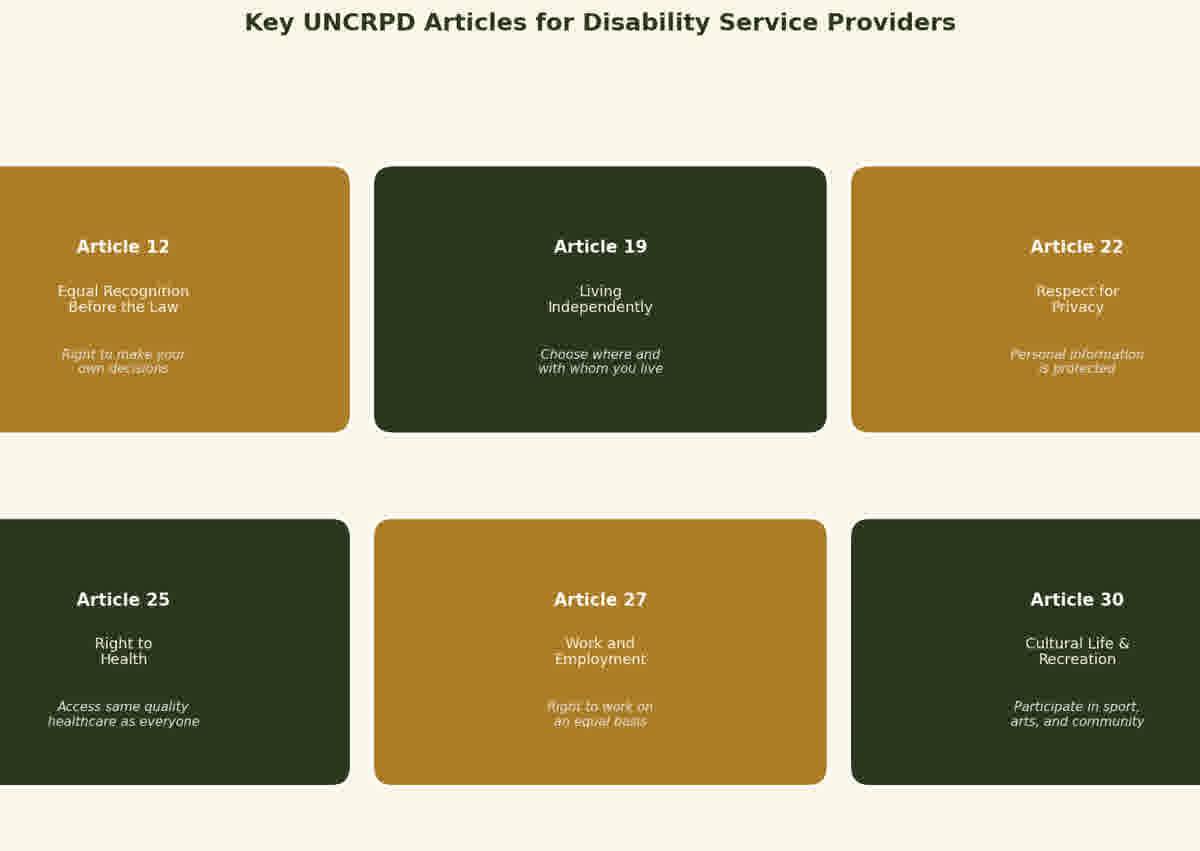
The following six articles represent the most direct obligations for disability service providers. Keep this as a reference when designing services, training staff, and reviewing your quality framework.
The UNCRPD has 50 articles, but for disability service providers in Australia, six articles have the most direct impact on daily practice. Understanding what each one means — and how to translate it into action — is the first step toward genuine rights-based service delivery. This is where UNCRPD disability services alignment begins: not in policy documents, but in the lived experience of the people you support.
Article 12 — Equal Recognition Before the Law
Article 12 establishes that people with disability have the right to be recognised as persons before the law — on an equal basis with others. This means the right to make your own decisions: to sign contracts, manage finances, choose where you live, and direct your own support.
In practice, this means moving away from substituted decision-making — where someone else decides what's "best" — toward supported decision-making, where the person retains the decision and receives the support they need to make it. For support workers, this means asking "what do you want to do?" before "what do I think is best?" It means taking the time to explain options clearly, checking for understanding, and respecting choices — even when you'd choose differently.
Article 12 in daily practice: Before arranging any support, service, or accommodation change, ask yourself: "Has this person been genuinely involved in making this decision? Do they understand their options? Is their preference driving this outcome?" If the answer is no, stop and re-engage the person before proceeding.
Article 19 — Living Independently and Being Included in the Community
Article 19 is one of the most powerful in the UNCRPD for disability service providers. It affirms the right of people with disability to choose where they live, with whom they live, and to not be obliged to live in any particular living arrangement. It also requires that community services are available to people with disability on an equal basis with others.
This article directly challenges services that warehouse people with disability in congregate settings without genuine choice, or that provide support on the provider's schedule rather than the person's. In the Supporting with Heart book — a guide to values-based practice for the disability sector — this is described as the difference between "care" that controls and "support" that liberates.
Practical tip: Review your rostering and service delivery practices. Are support hours structured around what's convenient for the organisation, or what works for the person? Article 19 compliance starts with genuinely flexible, person-directed scheduling.
Article 22 — Privacy
Article 22 protects the privacy of people with disability, including their personal and health information. This is often overlooked in practice settings where information about a person's disability, health status, or personal circumstances is shared casually — in handover meetings, in open offices, or in files visible to unauthorised staff.
For providers, Article 22 means building robust privacy practices into everyday operations. Case notes should be need-to-know only. Conversations about participants should happen in private spaces. People with disability should understand what information is collected about them, why, and how to access or correct it.
Article 25 — Health
Article 25 affirms that people with disability have the right to access health services on an equal basis — including sexual and reproductive health — without discrimination. In practice, this means support workers actively facilitating healthcare access, not acting as gatekeepers. It means preparing people for medical appointments, supporting them to communicate their symptoms and concerns, and ensuring that healthcare providers receive disability-accessible communication.
Article 27 — Work and Employment
Article 27 protects the right of people with disability to work on an equal basis in an inclusive, accessible work environment. For service providers, this is both an obligation toward participants — supporting employment goals as a genuine priority — and an internal responsibility. Organisations that support people with disability in employment should also be inclusive employers themselves.
Article 30 — Participation in Cultural Life, Recreation, Leisure and Sport
Article 30 recognises that participation in arts, culture, sport, and leisure is not optional or a "nice to have" — it's a human right. Support that only addresses physical or medical needs, without enabling the person to pursue what brings them joy and meaning, is incomplete. This is an area where B-HART's values-driven approach has always been distinctive: supporting the whole person, not just their functional needs.

The UNCRPD in Daily Practice: What Each Right Looks Like
Understanding the UNCRPD articles is one thing. Embedding them in day-to-day practice is another. Rights-based practice isn't a checklist — it's a culture. But concrete examples help. Here's what alignment with key UNCRPD principles looks like on the ground.
| UNCRPD Article | Compliance Failure Example | Rights-Based Practice Example |
|---|---|---|
| Article 12 — Equal recognition | Support worker books medical appointments without asking the person's preference for doctor, time, or format | Worker asks the person which doctor they prefer, when they want to go, and how they'd like to communicate with the GP |
| Article 19 — Independent living | Person is moved to a group home because it's "easier to manage" — without being offered alternatives | Person is presented with multiple living options, supported to understand each, and their preference guides the outcome |
| Article 22 — Privacy | Staff discuss a participant's diagnosis and behaviours in the break room or in front of other participants | All participant information is shared only with those who need it, in private settings, with the person's knowledge |
| Article 25 — Health | Support worker decides a person "doesn't need" a specialist referral and doesn't raise it with the doctor | Worker supports the person to communicate their own health concerns and facilitates the referral they've requested |
| Article 30 — Cultural participation | Community access support is only used for grocery shopping and medical appointments | Support is used for concerts, sports clubs, art classes, and other activities the person values |
How Providers Can Self-Assess UNCRPD Alignment
Most disability service providers don't have a dedicated human rights team. But every organisation can build a simple self-assessment practice into their quality cycle. The goal isn't perfection — it's honest reflection followed by meaningful action. As the NDIS Quality and Safeguards Commission notes, a rights-based approach requires providers to actively demonstrate how their services uphold participant rights, not just state that they do.
A good self-assessment asks three questions at every level of your organisation: Are we enabling rights, or just allowing them? Are we asking people what they want, or telling them what they'll get? And when someone's rights are at risk, do we have the systems and culture to speak up?
Map your services to the key UNCRPD articles
For each service you deliver, identify which articles are most relevant. SIL services connect most directly to Articles 19 and 12. Health support connects to Article 25. Community access connects to Article 30. This mapping helps you focus your assessment where it matters most.
Review your documentation and processes
Check support plans, incident reports, and service agreements. Do they reflect the person's own goals and preferences, or the organisation's defaults? Are decisions documented with the person's voice present — or just recorded outcomes?
Talk directly with the people you support
Ask participants: Do you feel heard? Do you feel you have real choices? Do you know your rights? What would you change? This feedback is the most direct indicator of rights alignment — and it's often the most uncomfortable, which is exactly why it's the most valuable.
Identify gaps and create a response plan
Document what you find honestly. For each gap, define a specific, time-bound action. Assign responsibility. Review at your next quality meeting. The UNCRPD isn't a compliance exercise you complete once — it's an ongoing commitment to doing better.
Train and engage your workforce
Rights-based practice lives or dies in the behaviour of individual support workers. If your team can't explain what the UNCRPD means for their daily work, the framework won't translate into lived experience for participants. Regular, practical training is non-negotiable.
The Connection to Australia's DSI Act 2023
The Disability Services and Inclusion Act 2023 (DSI Act) is the primary federal legislation governing disability services in Australia. It replaced the 1986 Disability Services Act and was designed to more directly align Australian law with the UNCRPD. This is the domestic legal framework that providers must comply with — and it draws heavily on the rights and principles the UNCRPD enshrines.
The DSI Act emphasises inclusion, participation, and the right of people with disability to be at the centre of decisions about their own lives. It requires that funded organisations deliver services that uphold these values — not as optional extras, but as core obligations. For registered NDIS providers, this means your service delivery framework must be grounded in rights-based practice, with evidence to demonstrate it.
The DSI Act 2023 includes specific provisions requiring that disability services are delivered in ways that promote the independence of people with disability, respect their dignity, and support their full participation in Australian life — all principles drawn directly from the UNCRPD. Non-compliance risks not just reputational damage, but potential deregistration.
Organisations like People with Disability Australia (PWDA) have consistently advocated for the DSI Act to be enforced with real teeth — and for providers to be held to account when their services fall short of the rights standard. The message for providers is clear: voluntary good intentions are no longer enough. Rights alignment must be demonstrable.
How B-HART Certification Embeds UNCRPD Principles
B-HART certification exists precisely because the UNCRPD — and the rights-based practice it demands — cannot be achieved through good intentions alone. It requires a structured, verifiable commitment. The B-HART framework translates abstract rights into measurable practice standards, giving providers a pathway to demonstrate that their services genuinely uphold the dignity and rights of the people they support.
Every element of the B-HART certification process maps to UNCRPD principles. The competency standards for support workers are grounded in Articles 12 and 19 — ensuring that workers understand supported decision-making and genuinely promote choice and independence. Organisational standards draw on Articles 22 and 25, embedding privacy and health advocacy into operational practice. And the community participation standards reflect Article 30, ensuring that meaningful inclusion is an active goal rather than a background aspiration.
"Human rights in disability services aren't a certification requirement to be ticked off — they're the reason the work matters in the first place."
— B-HART TeamFor providers who have completed B-HART certification, the UNCRPD is not a distant international standard — it's woven into their service delivery model. Participants and their families can see the difference: support that genuinely asks what matters to them, that builds capacity rather than dependence, and that treats every person as an expert in their own life. That's what B-HART certification means in practice.
If your organisation is beginning the journey toward rights-based practice, read our guide on rights-based practice for support workers — moving beyond compliance. And if you're exploring how trauma-informed approaches connect to human rights, our post on trauma-informed care in disability services is a strong companion read.
A note on language: Throughout this guide — and in all B-HART resources — we use person-first language: "people with disability", not "disabled people". This reflects the UNCRPD's framing and respects individual preference. Some people prefer identity-first language ("disabled person"), and it's always best to ask the person you're supporting which they prefer.
CRPD Practical Guide: Building Your Rights-Based Action Plan
Applying the UNCRPD in your organisation doesn't require a law degree. It requires commitment, humility, and a willingness to keep asking better questions. A practical CRPD action plan for disability service providers has three core pillars:
Policy Alignment
Review all organisational policies against the six key UNCRPD articles. Update language, processes, and decision-making frameworks to reflect rights-based practice. This includes complaints processes, incident reporting, and service planning templates.
Workforce Development
Embed UNCRPD principles into induction, ongoing training, and performance review. Support workers should be able to name the relevant articles and explain what they mean for their daily work — not recite them, but genuinely apply them.
Participant Co-Design
Involve people with disability in designing the services that affect them. This isn't a consultation box to tick — it's an ongoing relationship where participant voices shape organisational direction. UNCRPD Article 4 requires that people with disability are closely consulted on all decisions that affect them.
Monitoring and Accountability
Set rights-based indicators in your quality framework. Track not just incidents and complaints, but positive rights outcomes: How many participants are pursuing employment? How many have exercised a change in living arrangement? How many feel genuinely heard?
- Supported decision-making frameworks embedded in all support planning
- Privacy practices reviewed and updated to meet Article 22 standards
- Community participation tracked as a quality outcome, not an afterthought
- Health advocacy training provided to all direct support workers
- Participant feedback mechanisms accessible, anonymous, and actively used
- UNCRPD principles referenced in service agreements and support plans
Key Takeaways
- The UNCRPD is a binding international treaty that directly shapes Australia's disability legislation, including the DSI Act 2023 — every registered provider must align with its principles
- Six key articles are most relevant to disability service providers: Articles 12, 19, 22, 25, 27, and 30 — covering decision-making, independent living, privacy, health, employment, and community participation
- Rights-based practice is not about compliance paperwork — it's a culture where every interaction respects the dignity, autonomy, and choices of the person being supported
- A practical UNCRPD self-assessment involves mapping services to articles, reviewing documentation, gathering participant feedback, identifying gaps, and training the workforce
- B-HART certification directly embeds UNCRPD principles into measurable practice standards, giving providers a structured pathway to demonstrate genuine rights alignment
- Person-first, warm, and empowering language is part of rights-based practice — how you speak about and to people with disability matters
Frequently Asked Questions
What does UNCRPD stand for and why does it matter for disability services?
UNCRPD stands for the United Nations Convention on the Rights of Persons with Disabilities. It's an international human rights treaty that Australia ratified in 2008, creating a legal obligation to uphold the rights of people with disability. For disability service providers, it matters because it underpins Australia's domestic disability legislation — including the DSI Act 2023 — and sets the standard for what rights-based, person-centred service delivery looks like in practice.
How does the UNCRPD connect to the NDIS?
The NDIS was designed to be consistent with the UNCRPD's principles of independence, choice, and inclusion. Registered NDIS providers are required to deliver support that upholds participant rights, and the NDIS Quality and Safeguards Commission uses rights-based frameworks — grounded in the UNCRPD — to assess provider quality. In short, if you're a registered NDIS provider, the UNCRPD is not an optional extra: it's embedded in your regulatory obligations.
What is the difference between supported decision-making and substituted decision-making?
Substituted decision-making means someone else makes decisions on behalf of a person with disability — often based on what they think is best for the person, not what the person wants. Supported decision-making, which is what the UNCRPD requires under Article 12, means the person with disability retains the decision and receives whatever support they need to make it. The difference is profound: one removes agency, the other builds it.
What is human rights disability providers certification, and how does B-HART help?
Human rights disability providers certification means having a verified, structured framework that demonstrates your services genuinely uphold the rights of people with disability under the UNCRPD and Australian legislation. B-HART certification provides exactly that — a structured competency and organisational standard that maps to UNCRPD principles, giving providers and participants confidence that rights-based practice is not just stated, but demonstrable.
Is the UNCRPD legally binding in Australia?
Australia ratified the UNCRPD in 2008, which creates an international legal obligation to implement its principles. While the UNCRPD itself isn't directly enforceable in Australian courts, its principles have been incorporated into domestic legislation — including the DSI Act 2023 and the NDIS Act — which are binding on providers. Australia also has an Optional Protocol, allowing complaints to the UN Committee on the Rights of Persons with Disabilities in certain circumstances.
Embed Human Rights at the Heart of Your Practice
B-HART certification gives your organisation a structured, verifiable pathway to UNCRPD alignment — turning principles into measurable practice standards that participants, families, and regulators can see and trust.
Explore B-HART CertificationLearn more about our approach on the B-HART About page, or read our guide to rights-based practice for support workers.