
HRPA training — delivered through Human Rights Practice Australia, B-HART's partner learning organisation — is reshaping how disability sector workers understand and apply human rights in their everyday practice. If you've been searching for a structured, evidence-based pathway to embed rights-based approaches into your organisation's culture, this guide explains what HRPA training is, who it's designed for, and what it delivers for support workers, managers, and the people they support.
What Is HRPA Training?
Human Rights Practice Australia (HRPA) is a specialist learning organisation dedicated to building rights-based capability across the disability sector. HRPA training is not a compliance tick-box. It is a structured, progressive learning experience that takes workers and leaders from foundational understanding through to skilled, reflective practice — and ultimately to recognised certification.
The training is grounded in international human rights law, particularly the UN Convention on the Rights of Persons with Disabilities (UNCRPD), which Australia ratified in 2008. Rather than treating the UNCRPD as a policy document on a shelf, HRPA training translates its principles — dignity, autonomy, inclusion, and participation — into practical tools that workers can use in daily conversations, planning, and decision-making.
B-HART has partnered with HRPA because this approach aligns directly with B-HART's mission: to embed human rights into the lived experience of every person receiving disability support. Together, HRPA training and B-HART certification form a coherent, sector-leading pathway that connects learning to recognised organisational quality.
About HRPA: Human Rights Practice Australia is B-HART's official partner learning organisation. HRPA courses are purpose-built for the disability sector and informed by the UNCRPD, the NDIS Quality and Safeguards Commission framework, and leading practice in rights-based, trauma-informed support.
The HRPA Learning Pathway: From Foundation to Certification
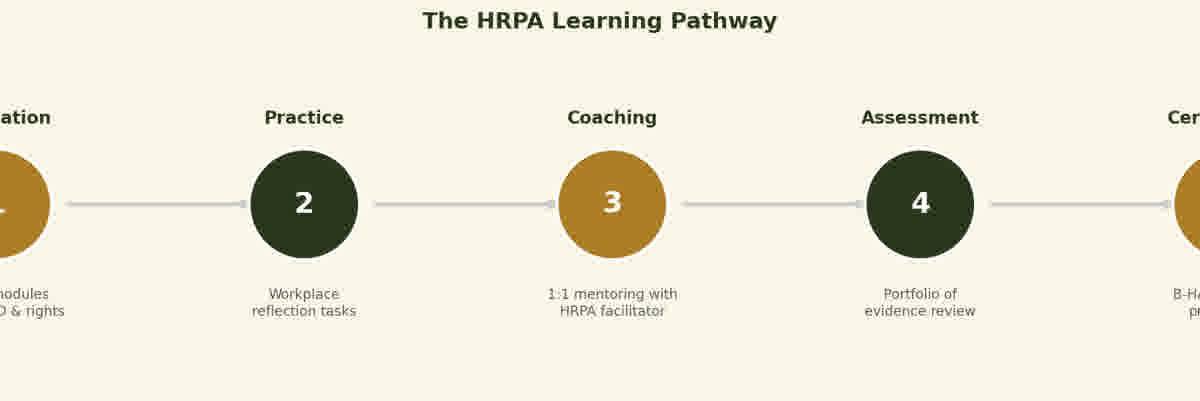
One of the defining strengths of HRPA training is its structured progression. Rather than offering a single workshop and leaving workers to figure out the rest, HRPA provides a coherent five-stage pathway that builds knowledge, skill, and confidence at each level. This learning architecture ensures that no stage is rushed, and that each participant — whether a frontline support worker or a senior leader — can engage at the level most relevant to their role.

Foundation
Builds core understanding of human rights principles, the UNCRPD, and what a rights-based approach means in disability support. Accessible to all workforce roles, including new or entry-level workers.
Practice
Deepens knowledge into applied skills — how to translate human rights principles into everyday support interactions, planning conversations, and team practice. Includes reflective practice tools and case-based learning.
Coaching
Equips team leaders and senior practitioners to coach colleagues in rights-based approaches. Develops the internal capacity to sustain culture change without relying solely on external training.
Assessment
Rigorous evaluation of knowledge and practice capability. Participants demonstrate their ability to apply human rights frameworks to real workplace scenarios, supporting genuine competency verification.
Certification
Successful completion of the full pathway leads to recognised certification that connects directly to B-HART organisational certification. Certification signals a sustained, verified commitment to rights-based practice — not just training attendance.
Who Is HRPA Training For?
HRPA training is designed for everyone in the disability support workforce — from frontline workers to board members. The pathway's multi-level structure means there is an appropriate entry point and progression route for every role. Critically, the training is not just for people who already believe in human rights. It is equally designed for teams working through the cultural shift from compliance-based practice to genuinely rights-centred support.
Support Workers
Build practical skills for rights-based, trauma-informed daily support. Understand how the UNCRPD applies to real interactions — from personal care routines to community access.
Team Leaders
Develop the tools to model and coach rights-based practice within teams. Bridge the gap between policy frameworks and frontline reality.
Coordinators & Managers
Embed rights-based approaches into supervision, rostering, incident review, and organisational governance. Lead culture change from within.
Executive & Board
Understand the strategic and governance dimensions of human rights leadership. Connect HRPA training to B-HART certification as an organisational quality signal.
For support workers in particular, HRPA training meets a gap that standard NDIS worker orientation modules do not fill. The NDIS Commission's worker orientation module provides a broad introduction to the scheme, but HRPA training goes deeper — connecting rights to reflective practice, lived experience, and the structural dynamics that can either protect or undermine a person's dignity. Learn more about this distinction in our post on rights-based practice for support workers: moving beyond compliance.
What Participants Learn: Core Content Areas
HRPA training covers a set of interlocking content areas that together build a coherent, practical capability. Each area is grounded in evidence and directly relevant to the realities of disability support work in Australia.
The UNCRPD in Daily Practice
The UN Convention on the Rights of Persons with Disabilities provides the conceptual foundation for everything HRPA teaches. But HRPA training doesn't treat the Convention as abstract legal text. Participants learn to connect specific UNCRPD articles — such as Article 12 (equal recognition before the law), Article 19 (living independently and being included in the community), and Article 25 (health) — to concrete decisions they make every day. This might mean how they approach a conversation about choices at mealtimes, how they support a participant to attend a community activity, or how they document a concern about restrictive practice. You can read more about this in our guide to UNCRPD Article 19 and human rights in everyday disability services.
Reflective Practice
A hallmark of HRPA training is its emphasis on reflective practice — the ability to examine one's own assumptions, values, and behaviours in the context of supporting another person's rights. This is not simply a technique; it is a professional discipline. Workers who develop reflective practice skills are more likely to notice when their own responses are being shaped by unconscious bias, power imbalances, or risk-aversion rather than the genuine preferences and rights of the person they support.
As Pouya Farbod writes in Supporting with Heart: A Transformative Human Rights Approach to Disability Care: "True support means walking beside someone, not standing over them." This philosophy sits at the heart of what HRPA training cultivates — an orientation of humility, curiosity, and genuine partnership with the people being supported.
"Human rights are not abstract ideals. They are the foundation for dignity, respect, and everyday life."
— Pouya Farbod, Supporting with Heart
Rights-Based Positive Behaviour Support
Positive Behaviour Support (PBS) is a mandated framework for many disability providers, but it is often implemented in ways that prioritise risk reduction over genuine rights. HRPA training provides workers and practitioners with a rights-based lens for PBS — one that starts with understanding the meaning behind behaviour, prioritising the least restrictive response, and centring the dignity and autonomy of the person throughout the process. This is especially important given ongoing concerns about the use of restrictive practices in Australia, which remain a focal point for the NDIS Quality and Safeguards Commission and human rights bodies.
Know the threshold: Any use of a restrictive practice in disability support must be authorised, time-limited, and actively reviewed. Rights-based PBS training helps workers understand both the legal obligations and the human rights imperative to reduce and eliminate restrictions. See the NDIS Commission's restrictive practices guidance for regulatory requirements.
Trauma-Informed Approaches
Trauma-informed practice recognises that many people with disability have experienced significant trauma — including through the very systems designed to support them. HRPA training integrates trauma-informed principles throughout its curriculum, helping workers understand the neurological and emotional impact of trauma, recognise trauma responses in their own practice and in participants, and create interactions that are safe, predictable, and empowering. This is not a separate module added to the end of the course; it is woven through every content area. For more context, read our post on trauma-informed care in disability services.
How HRPA Training Connects to B-HART Certification
B-HART certification and HRPA training are designed to work together. HRPA training builds the individual and team capability that B-HART certification recognises at the organisational level. When an organisation's workforce completes the HRPA pathway, it creates the conditions for genuine, verifiable culture change — not just policy documentation or training records.
B-HART's certification framework assesses whether human rights principles are genuinely embedded in how an organisation operates — from governance and leadership through to frontline practice and participant experience. HRPA training is the practical engine that drives this embedding. Organisations that invest in the full HRPA pathway for their workforce find that the B-HART certification process becomes a natural progression, rather than a separate compliance burden.
To understand the full value of B-HART certification for your organisation and the people you support, read our post on why B-HART certification matters for providers and participants. For context on B-HART's broader mission and approach, visit the B-HART About page.
Starting point for organisations: If you're new to the HRPA pathway, begin with a workforce audit — understanding which roles have what level of existing human rights knowledge helps you plan a targeted, cost-effective training rollout rather than a one-size-fits-all approach.
Practical Outcomes: What Changes After HRPA Training
The case for investing in human rights training for disability services is not simply ethical — it is practical. Organisations that complete the HRPA pathway consistently report measurable improvements across four areas that matter to every disability provider.
Culture Change That Sustains Itself
Compliance-based training produces compliance-based behaviour. When workers learn to follow a checklist because they're required to, the behaviour stops when no one is watching. HRPA training works differently — by building genuine understanding of why human rights matter and developing the reflective skills to notice when rights are at risk, it creates internal motivation that persists beyond the training room. Workers begin to hold each other accountable in new ways, and leaders model the values they're asking teams to live by.
Workforce Retention and Engagement
The disability sector faces ongoing challenges with workforce retention. Workers who feel professionally developed, valued, and equipped to do meaningful work are more likely to stay. HRPA training signals to workers that the organisation takes their professional growth seriously — and that the work they do is grounded in something more significant than task completion. Organisations report that human rights training, particularly when it includes coaching and reflective practice, increases team cohesion and reduces the cynicism that can develop in high-demand support environments.
Participant Trust and Genuine Partnerships
People with disability are acutely sensitive to whether they are genuinely respected or merely managed. When support workers approach their role through a rights lens — noticing choices, asking rather than assuming, supporting decision-making rather than substituting for it — participants notice. Trust builds. And when trust exists between a participant and their support team, the quality of support improves in ways that no policy framework can mandate. HRPA training helps workers develop the relational skills that make trust possible.
Reduced Risk and Regulatory Confidence
Human rights violations in disability services often emerge not from malicious intent but from systems and cultures that have normalised low expectations, risk-aversion, and paternalism. HRPA training helps organisations identify and interrupt these patterns before they escalate into reportable incidents or regulatory concerns. Providers who can demonstrate active investment in rights-based training are better positioned in audit processes and better equipped to respond constructively when things go wrong.
The UNCRPD has been ratified by 186 countries, making it one of the most widely adopted human rights instruments in history. Yet research consistently shows that the gap between ratification and genuine implementation in disability services remains significant — making rights-based workforce training one of the most direct tools available to close that gap.
The Broader Context: Human Rights Training in Australian Disability Services
The push for rights-based practice in Australian disability services is not new, but it has intensified significantly in recent years. The Royal Commission into Violence, Abuse, Neglect and Exploitation of People with Disability — which concluded in 2023 — documented systemic patterns of rights violations and called for fundamental cultural transformation across the sector. The NDIS Quality and Safeguards Commission has progressively strengthened its expectations around worker capability, restrictive practice reduction, and participant safety.
Against this backdrop, HRPA training represents a proactive, forward-looking response. Rather than waiting for regulatory requirements to tighten further, organisations that invest in genuine human rights training are positioning themselves as sector leaders — demonstrating to participants, families, regulators, and funders that they are committed to the kind of practice the sector needs. For a deeper analysis of how the 2026 NDIS reforms intersect with human rights obligations, read our guide on beyond compliance: what the 2026 NDIS reforms mean for human rights in your organisation.
Key Takeaways
- HRPA training is delivered by Human Rights Practice Australia, B-HART's partner learning organisation, and provides a structured five-stage pathway from foundation knowledge to recognised certification
- The training is grounded in the UNCRPD and covers reflective practice, rights-based PBS, and trauma-informed approaches — translated into practical skills for daily support work
- HRPA training is designed for all disability workforce roles — support workers, team leaders, coordinators, managers, and executive leaders
- Completing the HRPA pathway creates the conditions for B-HART organisational certification, connecting individual learning to recognised sector quality
- Practical outcomes include sustained culture change, improved workforce retention, stronger participant trust, and greater regulatory confidence
- In the context of the Royal Commission recommendations and 2026 NDIS reforms, rights-based workforce training is no longer optional — it is a defining marker of sector leadership
Frequently Asked Questions
What does HRPA stand for and who delivers the training?
HRPA stands for Human Rights Practice Australia. It is B-HART's partner learning organisation, specialising in rights-based training for the disability sector. HRPA training is facilitated by experienced practitioners and is informed by the UNCRPD, the NDIS regulatory framework, and leading practice in reflective and trauma-informed support.
Is HRPA training the same as the NDIS worker orientation module?
No. The NDIS Commission's worker orientation module is a broad introduction to the NDIS scheme and is required for all NDIS workers. HRPA training goes significantly deeper — it builds applied human rights capability, develops reflective practice, and is structured as a multi-stage pathway rather than a single module. The two are complementary, not interchangeable.
How does HRPA training connect to B-HART certification?
HRPA training builds the individual and team capability that B-HART organisational certification recognises. Organisations whose workforce completes the HRPA pathway demonstrate the kind of genuine, embedded human rights practice that B-HART certification verifies. The two frameworks are designed to work together as a coherent quality pathway for disability providers.
Who should start with HRPA foundation training?
Any disability sector worker who is new to human rights frameworks — regardless of their role or experience level — can start with the Foundation stage. It is also appropriate for experienced workers who have not previously had formal human rights training, or for organisations undertaking a workforce capability review. Team leaders and managers may move directly into the Practice or Coaching stages depending on existing knowledge.
What is "Supporting with Heart" and how does it relate to HRPA training?
Supporting with Heart: A Transformative Human Rights Approach to Disability Care by Pouya Farbod is a foundational text that informs B-HART's and HRPA's approach to rights-based practice. The book provides a practical, values-driven framework for embedding human rights into daily support work and is recommended reading for anyone undertaking the HRPA training pathway.
Ready to Build Rights-Based Practice in Your Organisation?
HRPA training through B-HART gives your workforce the knowledge, tools, and reflective skills to deliver genuinely human rights-centred disability support. Whether you're starting with a single team or planning an organisation-wide rollout, we can help you find the right pathway.
Learn About B-HART and HRPA TrainingExplore our B-HART certification guide or read more about rights-based practice for support workers to understand how HRPA training connects to the bigger picture.